Almost every call we get about pet odor starts the same way. The customer has cleaned the spot — sometimes several times, sometimes with three different products — and it seemed fine for a week or two. Then a humid day arrived and the smell was back, in the same place, as strong as before.
That pattern is not a failure of effort. It is what happens when a treatment addresses the carpet and the source is somewhere else.
Where the Urine Actually Goes
Picture the spot from the side rather than from above. A dog or cat deposits liquid onto the carpet face. Only a small fraction of it stays in the yarn. The rest passes straight through the carpet backing and into the pad underneath, which is porous foam engineered to absorb and hold.
In the pad, liquid spreads sideways. A spot that reads as four inches across on the surface routinely measures twelve to eighteen inches across in the pad below. Whatever the pad cannot hold continues down to the subfloor, where it soaks into plywood or pools on a concrete slab and wicks along the seams.
So the visible stain is the top of an iceberg, and it is the least important part. You can scrub the surface perfectly and still be standing on the majority of the deposit.
| Layer | Roughly how much | What surface cleaning reaches |
|---|---|---|
| Carpet face yarn | A small share | All of it |
| Carpet backing | A modest share | Some |
| Pad | The largest share | None |
| Subfloor | Whatever the pad could not hold | None |
| Tack strip and baseboard | Edge spots only | None |
Why It Comes Back on Humid Days
Urine is mostly water, urea, salts, and bacteria. The water evaporates within a day or two. What stays behind is a crystalline residue — largely urea salts and uric acid compounds — sitting in the pad and the backing.
Those crystals are hygroscopic. They pull moisture out of the surrounding air, and once they are damp again, the bacterial breakdown restarts and the odor becomes airborne. That is the entire mechanism behind the smell that appears out of nowhere on a rainy Tuesday.
In Hampton Roads this matters more than almost anywhere. Our summer dew points keep indoor humidity elevated for months, so a deposit that would stay quiet in a dry climate is active here for a large part of the year. It is the same coastal moisture problem behind so much of what we deal with, just wearing a different hat.
What to Do Right Now for a Fresh Accident
If you catch it wet, you can remove a genuinely large share of it before anything sets. Speed matters more than product choice.
- Stack white towels over the spot and stand on them. Body weight pulls far more liquid out than blotting by hand does.
- Replace the towels and repeat until a fresh towel comes up nearly dry. Most people stop about three rounds too early.
- Rinse with cool water — a cup or so, poured slowly — and extract again with the same standing method.
- If you use an enzyme product, apply it after rinsing, use enough to reach past the backing, and keep the area damp and covered for several hours so the enzymes can work.
- Do not use a steam iron, a hot-water machine, or any heat. Heat sets the protein and locks the odor in permanently.
- Do not use vinegar and baking soda together. They neutralize each other and leave you with salty water and residue.
That routine handles a first-time accident on the surface. It does not handle a spot that has been used repeatedly, and it does nothing at all for a deposit that is already in the subfloor.
What Professional Treatment Actually Involves
Real urine work is a different job from carpet cleaning, and it is worth understanding what separates them.
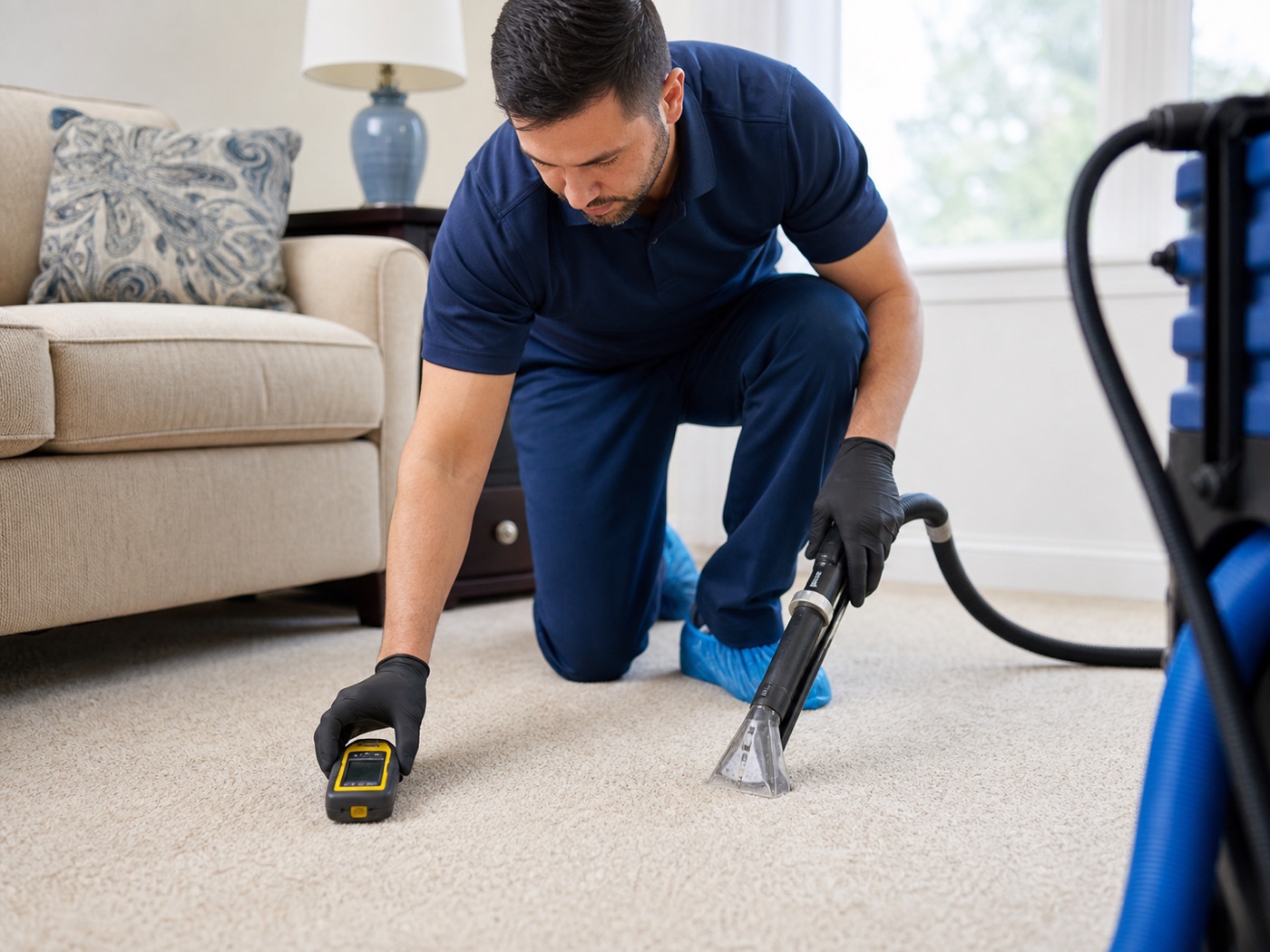
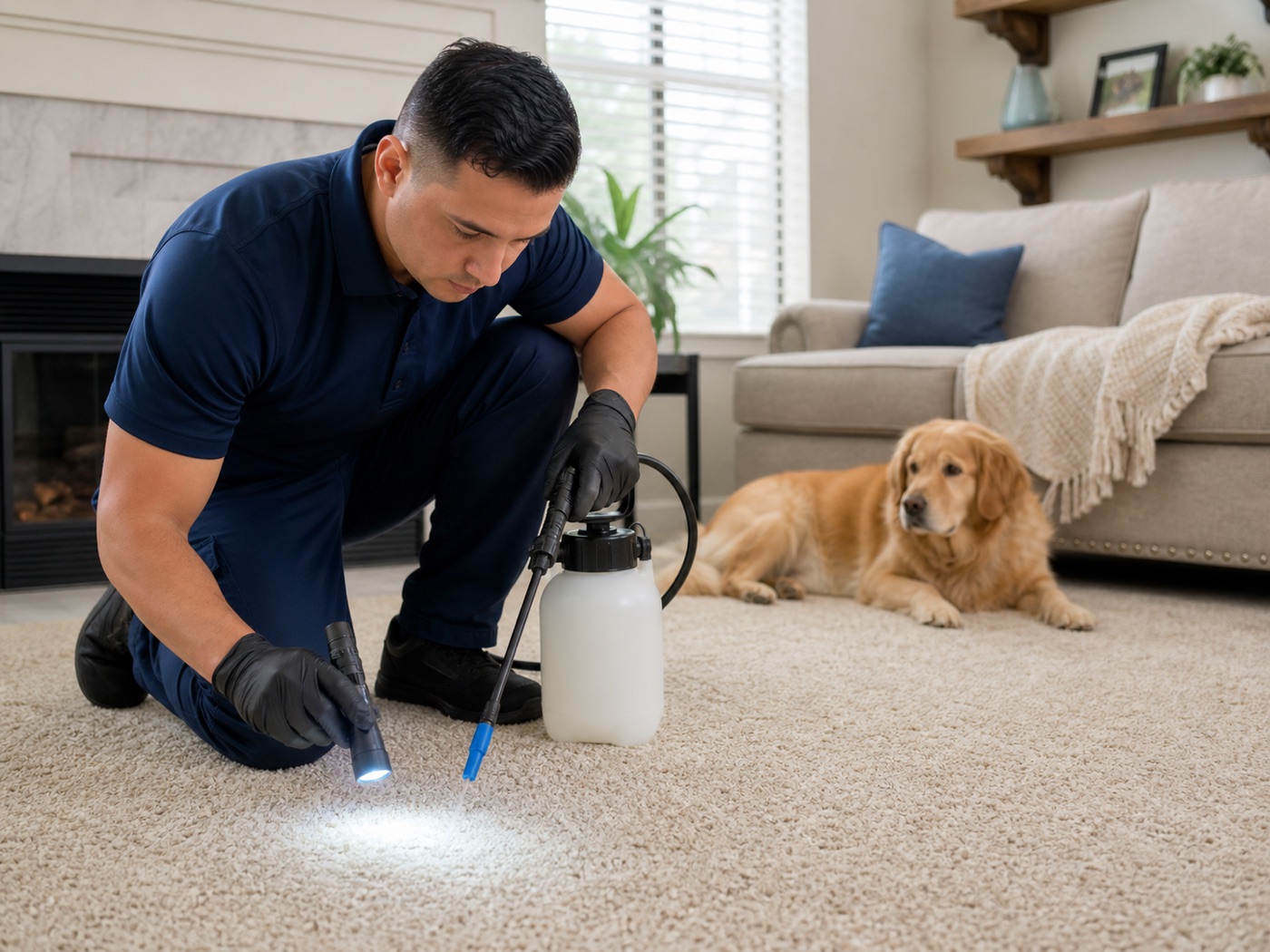
It starts with inspection. A UV light in a darkened room reveals deposits the eye misses, and a moisture meter confirms depth and boundaries. The mapping stage is what determines the price honestly — three small spots and one large saturated area are very different jobs, and neither should be quoted sight unseen.
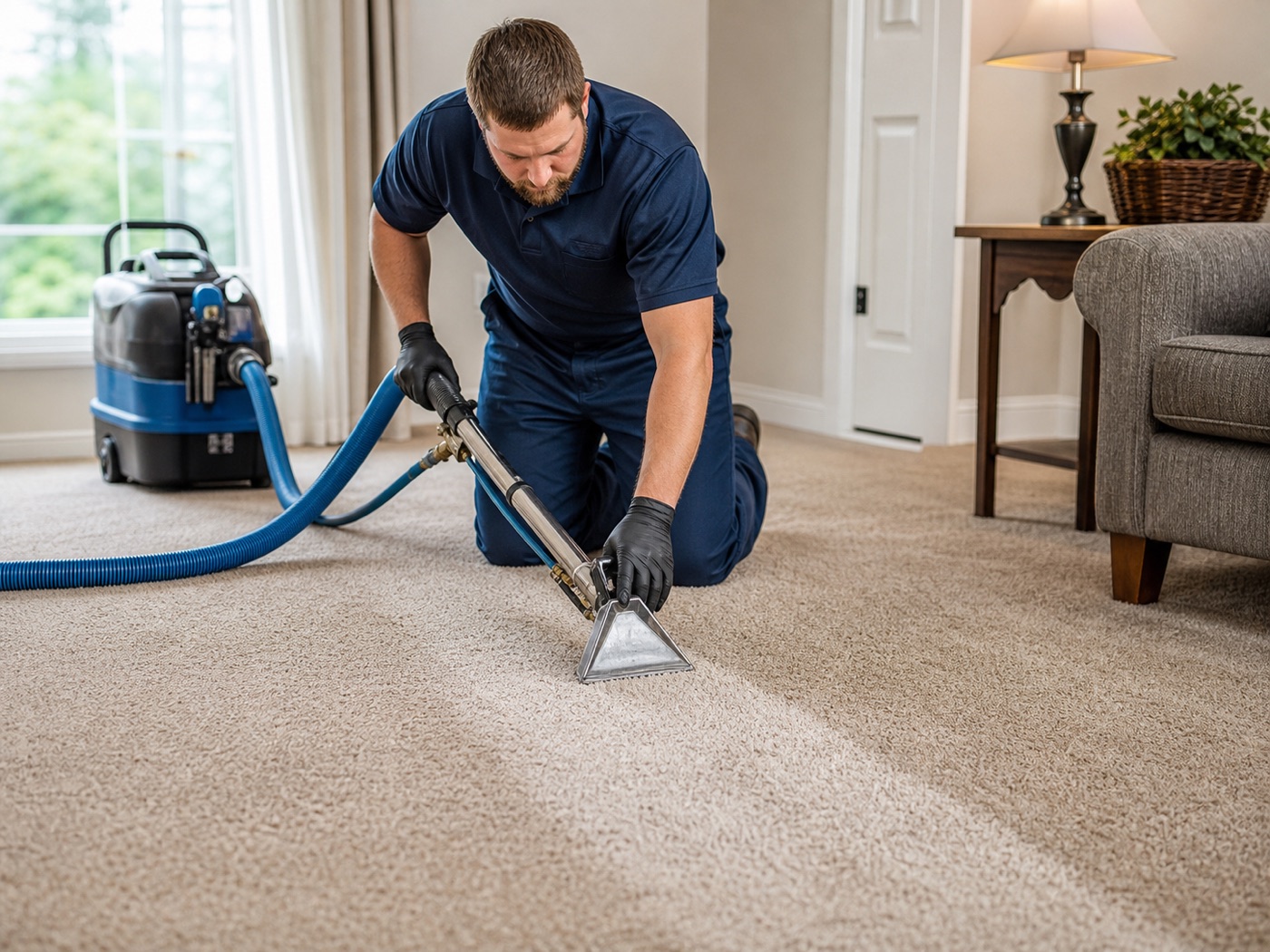
Then comes sub-surface treatment. A urine-specific product has to be injected into the pad and the backing, not sprayed on top, and it has to be given time to break down the uric acid rather than just rinse the fiber. For heavier spots that means flooding the area deliberately and then pulling everything back out with a sub-surface extraction tool that draws from beneath the carpet rather than across it.
In severe cases the right move is to pull the carpet back, remove and replace the affected section of pad, seal the subfloor, and then clean and reset the carpet. That sounds drastic, but for a spot that has been used for a year it is the only honest path — and it is still far cheaper than new carpet throughout.
Finally, the room gets a full cleaning so the treated areas do not stand out against everything around them. Treated spots come out noticeably brighter than the carpet around them, and a room with four bright patches in it looks worse than it did before anyone arrived. That last step is why urine work is usually paired with a general carpet cleaning rather than sold alone.
One thing worth setting expectations on: sub-surface work uses a lot of water by design, because the only way to get a contaminant out of a pad is to flush it and pull it back. Drying takes longer than an ordinary cleaning, and in a humid stretch we will usually leave air movers running or ask you to keep the room closed with the air conditioning on. That is a feature of the method rather than a mistake.
The Products That Make Things Worse
A few things sold for this problem actively set it back, and they come up often enough to be worth naming.
- Steam cleaners and hot extraction on an untreated urine spot. Heat denatures the protein and sets the stain and the odor into the fiber for good.
- Oxygen bleach products used at full strength on wool or on darker nylon. They can lift color along with the stain, and the result is permanent.
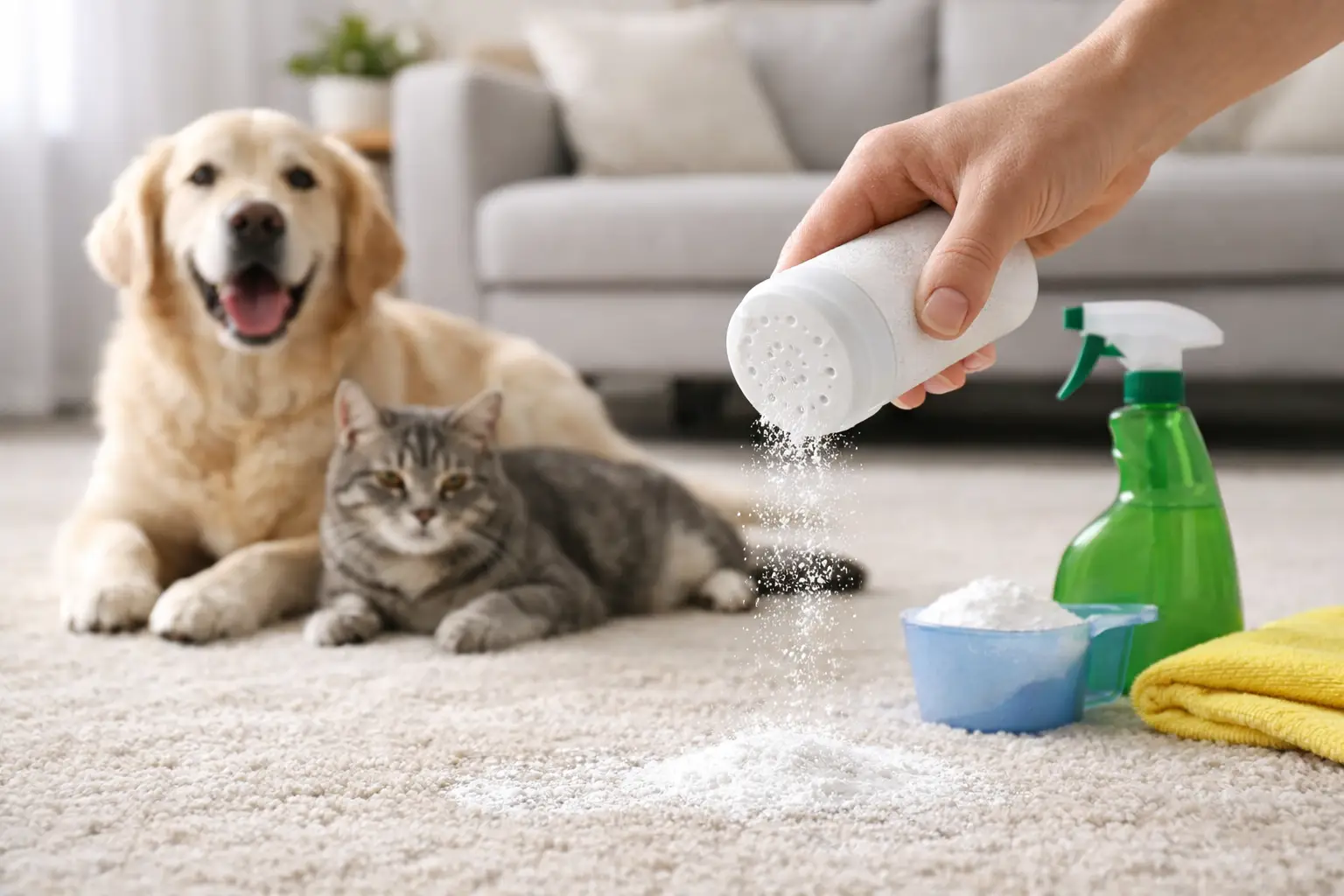
- Fragrance sprays and carpet powders. They cover the odor, add residue that attracts soil, and make it impossible to tell later which spots are still active.
- Vinegar poured on generously. It masks briefly, then leaves its own smell, and it does nothing to the uric acid crystals underneath.
- Household carpet shampoo run through a rental machine. The detergent stays behind, and the sticky residue makes the area re-soil faster than the rest of the room.
None of these are catastrophic on their own, but they stack. By the time a spot has had four products applied to it, the pad holds urine salts, detergent residue, and fragrance oil, and the cleanup is a longer job than it needed to be.
Stopping the Repeat Visit
Removal only holds if the animal stops returning to the same place, and animals return because they can still smell what we cannot.
A dog's nose resolves concentrations far below human detection. If any residue remains, the spot still reads as a marked location, and the behavior continues. This is why partial treatment often produces a frustrating cycle: the odor is gone for people, the signal is still there for the pet, and the spot gets refreshed within a week.
Two practical follow-ups help. Block access to the area for a couple of weeks after treatment while the behavioral association fades, and rule out the medical explanations — urinary tract infections, kidney issues, and age-related incontinence are common causes of a previously reliable animal suddenly having accidents. Cleaning will not fix a health problem.
It is also worth cleaning the rest of the household's soft surfaces at the same time. Dander, coat oils, and general pet soil build up in ways that compound the odor picture, and households with animals generally benefit from a shorter cleaning interval than the standard advice suggests.
When Replacement Is the Honest Answer
There is a point past which treatment stops being the better value, and a cleaner who never says so is not doing you a favor.
The markers are fairly clear: saturation across a large contiguous area rather than discrete spots, a pad that has broken down and gone crumbly, subfloor staining visible through the backing, or a history of years rather than months. At that stage the cost of aggressive treatment approaches the cost of new pad and carpet in that room, and the outcome is less certain.
Even then, the subfloor still has to be cleaned and sealed before new carpet goes down. Installing over an untreated subfloor is the most common reason a brand-new carpet smells like the old one within a month, and it is heartbreaking to watch.
All City Carpet Cleaning And Building Solutions handles pet urine work throughout Virginia Beach, Norfolk, Chesapeake, Suffolk, Hampton, Portsmouth, and Smithfield. We will tell you when a spot is treatable and we will tell you when it is not.