It is one of the most common calls we get in Hampton Roads, and it usually arrives with some exasperation attached. The carpet was cleaned. It smelled fine for about ten days. Now the room smells like a basement again, and the obvious conclusion is that the cleaning did not work.
Almost always, the cleaning worked. What did not happen is finding out where the moisture was coming from — and in this climate, that is the entire problem.
What Musty Actually Means
The smell people describe as musty, earthy, or basement-like is produced by microbial activity. Mold and mildew growing on organic material release volatile compounds as a byproduct, and human noses are remarkably good at detecting them at very low concentrations.
That growth needs three things: something to eat, a surface to grow on, and moisture. In a carpeted room, the first two are permanently available — dust, skin cells, food residue, and the fibers themselves — which means moisture is the only variable. Control moisture and the smell cannot establish, no matter how much organic material is present.
This is why cleaning alone is an incomplete solution. A thorough extraction removes the organic load and whatever growth is on it, which is genuinely useful and produces immediate improvement. But if the room returns to the same damp condition, new material accumulates within days and the process restarts. You are resetting a clock rather than stopping it.
Why This Region Is Particularly Prone
Hampton Roads sits at the intersection of several conditions that individually would be manageable and together are not.
The water table is high and much of the region is barely above sea level. Summer dew points run in the seventies for months. A great deal of the older housing stock sits over crawlspaces rather than slabs. And air conditioning, while it dehumidifies, also creates cold surfaces where warm humid air condenses — which is why supply ducts running through an unconditioned attic or crawlspace are a recurring source of moisture nobody sees.
The result is that a house here can have a genuine moisture problem without anything obviously broken. No leak, no flood, no visible water — just an assembly that never fully dries out between humid days.
Tracing the Source
The pattern of the smell tells you a great deal, and it is worth paying attention before spending money.
| What you notice | Likely source | Where to look |
|---|---|---|
| Worse in summer, better in winter | Ambient humidity or crawlspace | Hygrometer reading; crawlspace ground moisture |
| Strongest at room edges and baseboards | Moisture entering from below or behind the wall | Crawlspace, grading, gutters, exterior drainage |
| One room only, over an unconditioned space | Floor assembly moisture or duct condensation | Crawlspace vapor barrier; duct insulation |
| Near an exterior door or entry | Repeated wetting that never fully dries | Matting, door sweep, drainage at the threshold |
| Near an HVAC closet or air handler | Condensate pan or drain line | Pan, drain line, secondary drain |
| Strongest when the AC runs | Duct or plenum condensation | Duct insulation, sealing, and airflow |
| Followed a known water event | Residual moisture in pad or subfloor | Below the carpet — this rarely resolves itself |
The last row is the one that most often gets misdiagnosed as an odor problem. A carpet that was wet — from a storm, a leak, an appliance failure, or an over-wetted cleaning — and dried too slowly will smell, and the cause is in the pad rather than the fiber. That situation follows its own rules about what can be saved.
The Crawlspace Is the Usual Suspect
In older Norfolk, Portsmouth, and Hampton neighborhoods especially, the crawlspace explains more musty first floors than everything else combined.
A crawlspace over bare earth evaporates ground moisture continuously into the space beneath your floor. Traditional vented crawlspaces were designed on the theory that outdoor air would carry that moisture away — which works in a dry climate and actively backfires in a humid one, because the outdoor air being brought in is itself carrying a great deal of moisture that then condenses on cool surfaces underneath the house.
The signs are consistent: the smell is worse in summer, worse on the first floor, worse near exterior walls, and it returns predictably after any cleaning. Sometimes there is visible efflorescence on foundation walls or rusting on ductwork below.
The fixes belong to other trades — a sealed ground vapor barrier, corrected grading and gutters so surface water moves away from the foundation, and in many cases encapsulation with conditioned air or a dedicated dehumidifier. None of that is carpet cleaning, and a cleaner who keeps selling you cleanings against this pattern is selling you a subscription to a symptom.
What Cleaning Legitimately Does
None of this means cleaning is pointless. Once the source is identified and being addressed, thorough extraction is exactly the right step, and it does several things at once.
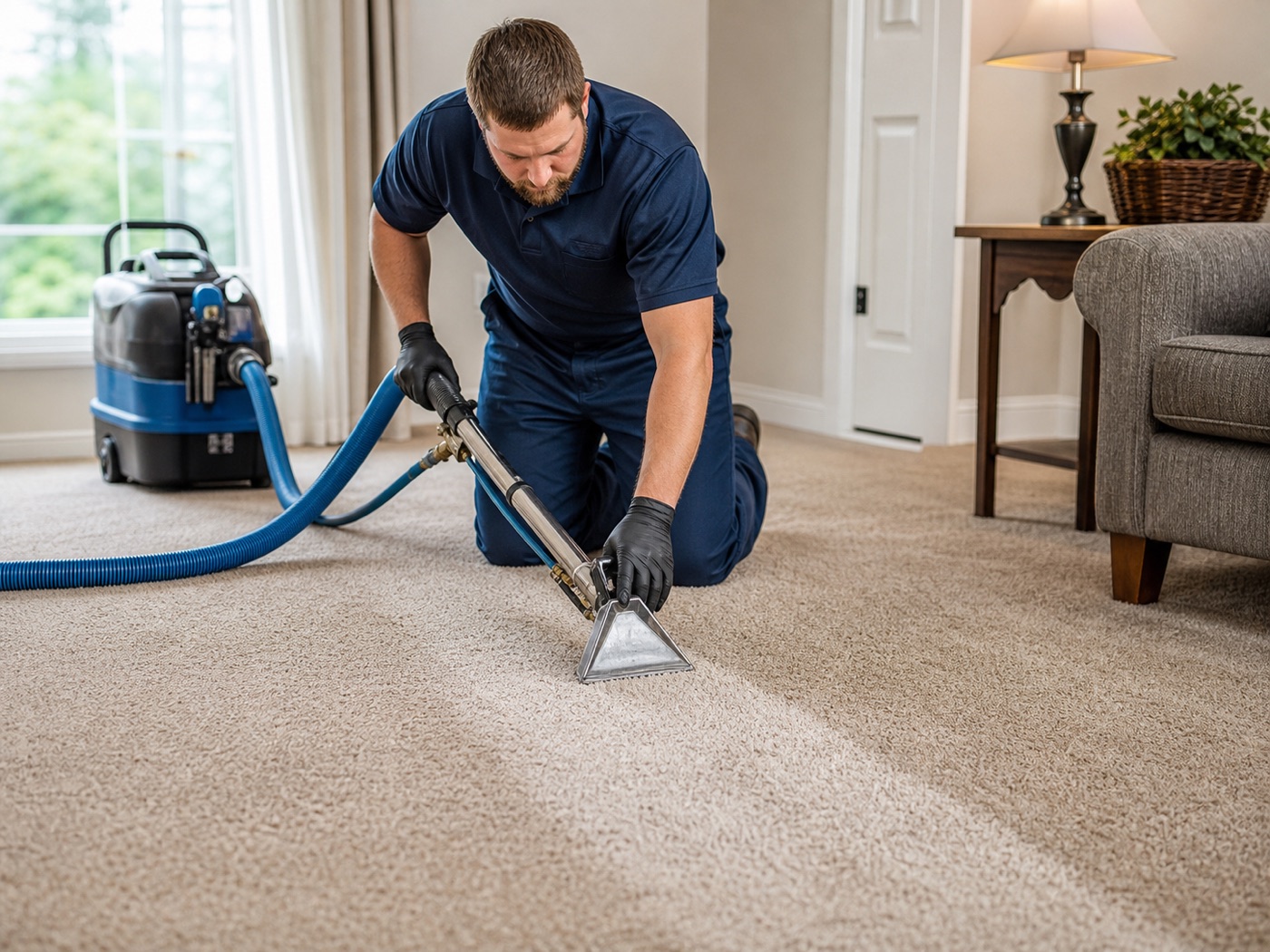
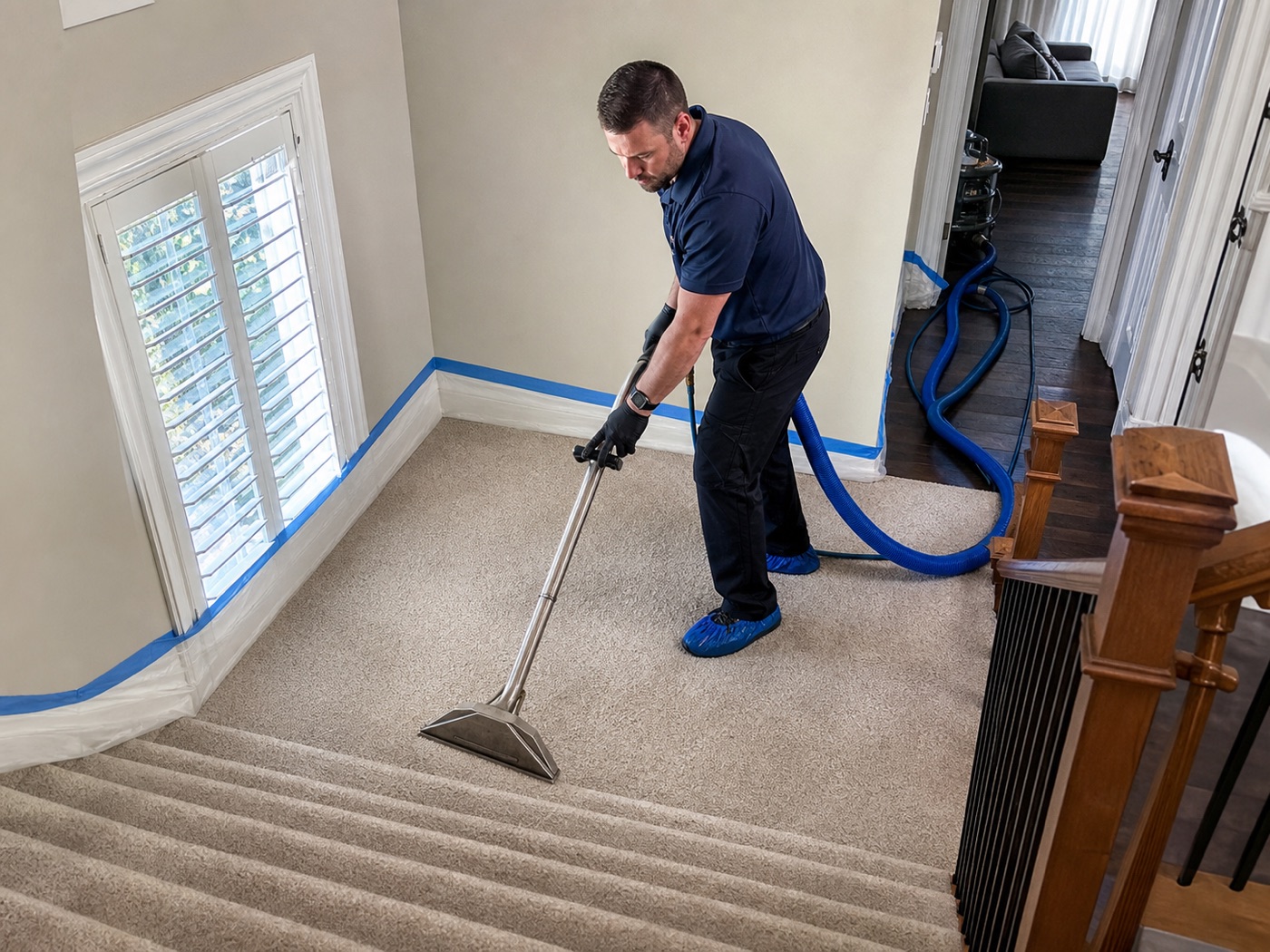
It removes the accumulated organic material that growth feeds on, along with whatever has already established on the fiber. It removes the soil that holds moisture against the carpet. And done properly, with controlled application and thorough recovery, it leaves the floor drier than it found it rather than adding to the problem — which is the part that separates a good job from one that makes things worse.
Sequence matters. Cleaning a carpet while the source is still active buys ten days. Correcting the source and then cleaning gets you a floor that stays clean. If you are only going to do one, do the source first.
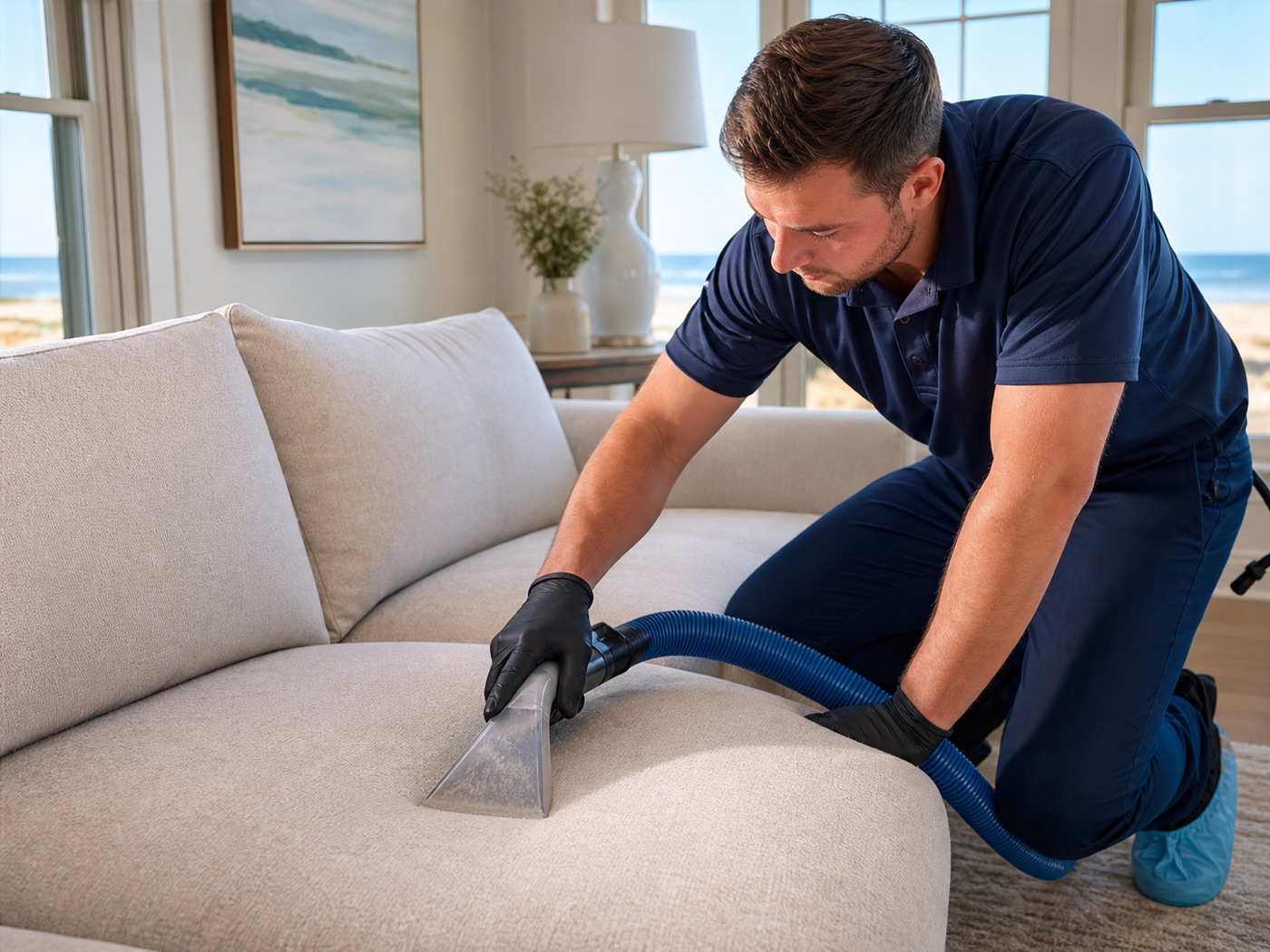
Soft furnishings in the same room deserve attention at the same time. Sofas, chairs, and cushions hold far more moisture and organic material than most people credit, dry much more slowly than carpet, and are frequently the actual source in a room where the floor has already been dealt with.
The Closed-Up Room Problem
One version of this has no leak, no crawlspace issue, and nothing broken at all. It is simply a room that does not get air.
Guest bedrooms with the door shut for months, finished bonus rooms over garages, basements, closets against exterior walls, and vacation properties left at eighty-five degrees between bookings all share the same condition: stagnant air at high humidity, indefinitely. Nothing needs to go wrong for mildew to establish in that environment — it is the default outcome in a coastal climate.
The fix is circulation rather than cleaning. Leave interior doors open so conditioned air reaches the room. Make sure supply and return vents are not blocked by furniture, and that closing the door does not cut the room off from the return entirely. Run a fan in a room that has no good airflow, and put a dehumidifier in one that stays above fifty percent regardless.
For a property that sits empty — a rental between seasons, a second home — the single most valuable habit is not setting the thermostat so high that the air conditioning never runs. A system that never cycles never dehumidifies, and a closed coastal house at eighty-five degrees will smell noticeably stale within weeks.
What Not to Do
- Do not mask it. Plug-ins, sprays, and scented powders cover the smell for a few days and leave residue that attracts soil.
- Do not shampoo it repeatedly. Each round adds moisture to a room that already cannot dry, and detergent residue makes the carpet re-soil faster.
- Do not open windows on a humid day to air it out. You are importing the moisture that is causing the problem.
- Do not assume it is the carpet because that is where you can smell it. Carpet is a large absorbent surface near the floor, so it registers a room's problem first.
- Do not ignore a musty smell that appears suddenly. A new smell usually means a new source, and a slow leak found early is much cheaper than one found late.
The masking point is worth repeating because it is so widely done. A heavily fragranced room reads to most people as a room hiding something, and in this case that is exactly right. The distinction between covering a smell and removing what causes it applies to every odor problem, not just this one.
The Short Version
Musty carpet in Hampton Roads is a moisture story nearly every time. Put a hygrometer in the room, read the pattern of when and where the smell is strongest, and look below the floor before looking at it. Get the humidity under fifty percent and keep it there, correct whatever is supplying water, and then clean — in that order.
All City Carpet Cleaning And Building Solutions serves Virginia Beach, Norfolk, Portsmouth, Chesapeake, and Hampton. If your carpet keeps smelling after it has been cleaned, we would rather help you find the cause than sell you the same service again.