
Winter in Hampton Roads is not the winter people picture when they read carpet care advice written for Chicago. We get a handful of genuine snow or ice events in a typical year and a great deal of rain, and the ground stays soft and wet for weeks at a stretch.
That produces a specific entryway problem: mostly mud, punctuated by a few days of ice melt residue that then lingers in the carpet for months. The two need opposite responses, and doing the wrong one is how a manageable mess becomes a permanent mark.
Mud Wants to Be Left Alone First
The instinct when someone tracks mud across a carpet is to grab a wet towel immediately. That instinct is wrong, and it is the single most common way a small mud problem becomes a large one.
Wet clay is a suspension of very fine particles in water. Wiping it moves that suspension outward across clean fiber and simultaneously presses the particles down into the pile, where they lodge between fibers rather than sitting on top. A footprint's worth of mud becomes a three-foot smear that is now embedded rather than surface-level.
Dry clay behaves completely differently. Once the water is gone, the particles are loose aggregate sitting in and on the fiber, and a vacuum removes a large share of it mechanically. What remains is a much smaller stain in a much smaller area, and it responds far better to treatment.
This matters more here than in most places because the soil in Chesapeake, Suffolk, and much of the region is clay-rich and iron-bearing. That iron content is what leaves the orange-tan cast on light carpet after the obvious dirt is gone, and it is genuinely stubborn once it is worked into the yarn. Knowing which marks respond to treatment and which do not saves a lot of pointless scrubbing.
Ice Melt Is a Chemistry Problem
During the two or three days a year Hampton Roads actually ices over, sidewalks, parking lots, and front steps get treated with rock salt or a calcium or magnesium chloride blend. That material does not stay outside.
Salt tracked in on a wet shoe arrives dissolved. It soaks into the carpet as a solution, and when the fiber dries the salt recrystallizes in place — which is why a white haze or crusty patches appear a day or two after the mess seemed cleaned up. Vacuuming does not touch it, because by the time it is visible it has already bonded into the fiber rather than sitting on it.
Beyond looking bad, salt residue is hygroscopic: it pulls moisture out of the air and holds it. Carpet carrying salt stays subtly damp, feels stiff or crunchy underfoot, and re-soils noticeably faster because damp fiber grabs everything walked into it. In a commercial entry that has taken a full winter of this, the difference between the treated entry zone and the rest of the floor is usually obvious.
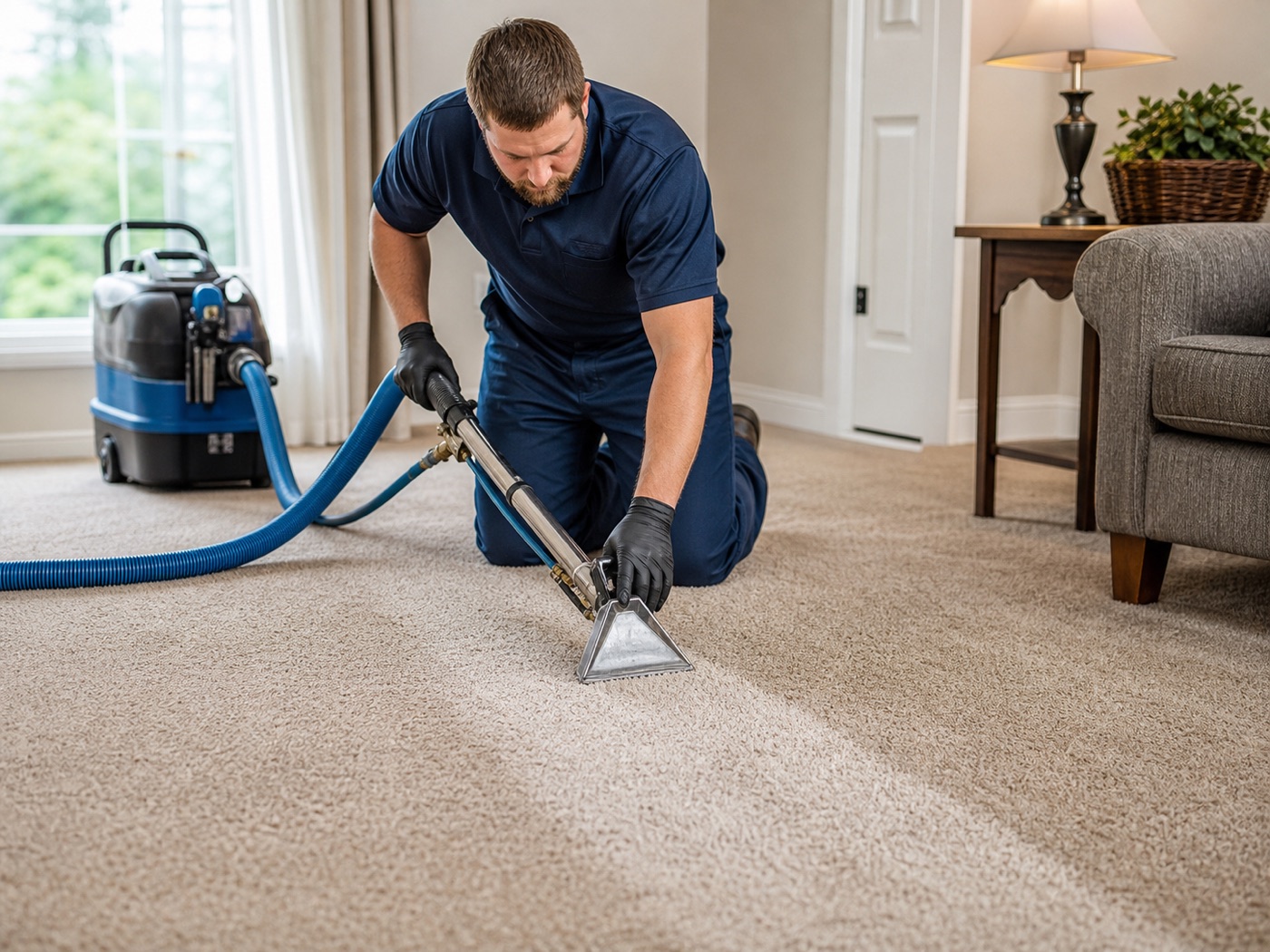
The fix is rinsing, not vacuuming. Salt has to be dissolved back into solution and extracted, which means a wet process with adequate recovery. This is a case where a proper extraction is not optional — a low-moisture surface pass will not remove a salt that has penetrated the yarn.
| What arrived | How it behaves | What to do |
|---|---|---|
| Mud and wet clay | Fine particles that spread when wet, loosen when dry | Let it dry, vacuum thoroughly, then treat the remainder |
| Ice melt and rock salt | Dissolves, penetrates, recrystallizes on drying | Rinse and extract — vacuuming has no effect |
| Standing water at the door | Soaks the pad and stays there | Blot, add airflow, and get the pad dry |
| Leaf and organic debris | Stains as it decomposes against fiber | Remove promptly; this one should not wait |
| Sand mixed in with any of it | Abrades the fiber under traffic | Vacuum slowly and often through the wet season |
The Wet Carpet Nobody Notices
The third winter problem is not soil at all. It is water, arriving a little at a time over weeks, and never fully leaving.
An entry carpet in a rainy stretch absorbs moisture from every set of shoes that crosses it. During a Hampton Roads winter, outdoor humidity is often high enough that the carpet never gets a real chance to dry between events. The result is a strip of carpet inside the door that has been slightly damp continuously since November.
That is exactly the condition that produces a musty entry smell, and it is also where the pad underneath starts holding moisture against the subfloor. People typically attribute the smell to dirt and clean the carpet, which adds more water to a floor that is already struggling to dry. The order of operations matters: get it dry, then clean it, and give it real airflow afterward rather than relying on the room to sort itself out.
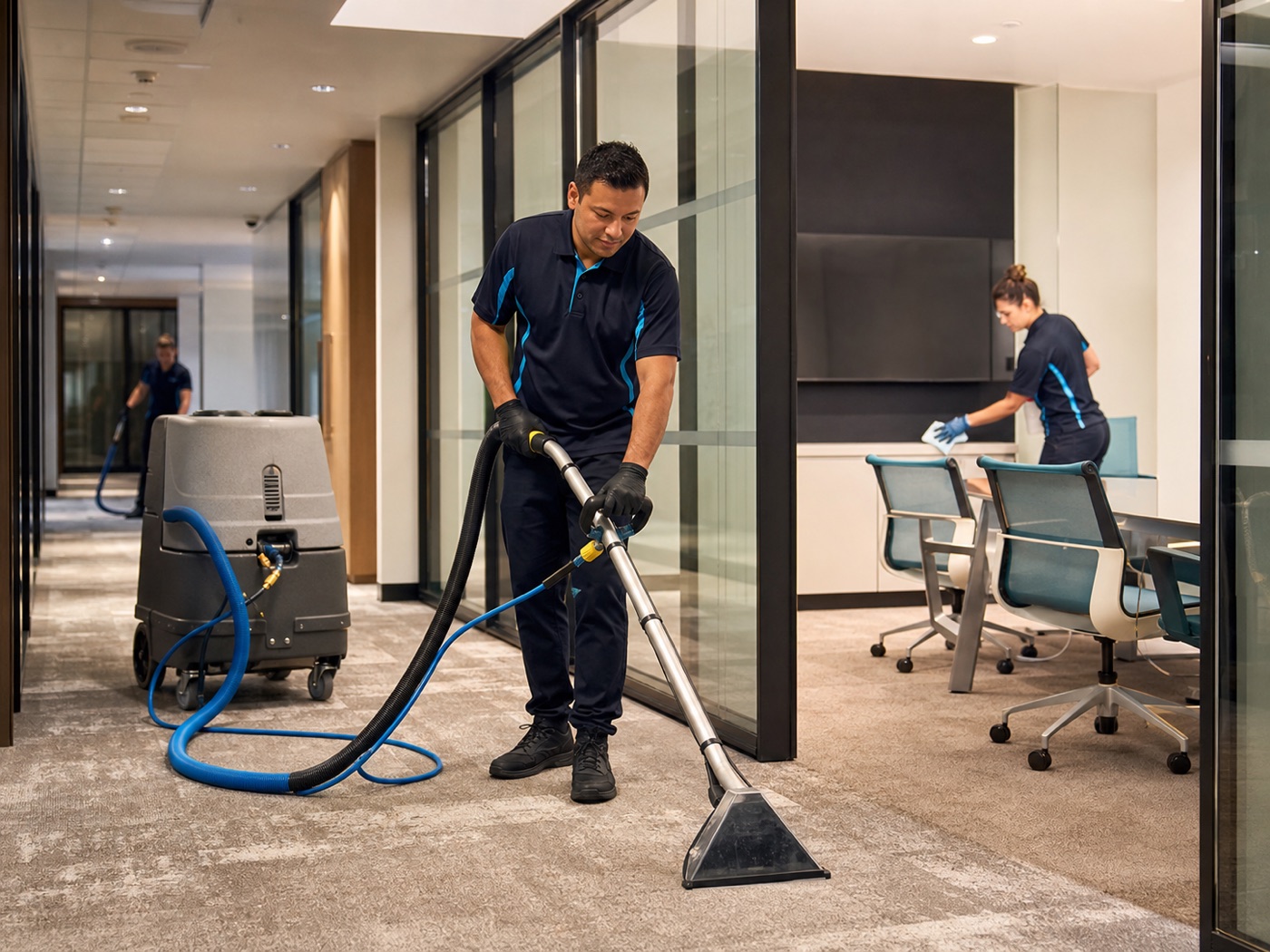
For commercial entries the same thing happens at a much larger scale, and it is compounded by liability — a persistently damp entry mat over a hard floor is a slip hazard as well as an odor source. Buildings that manage this well change matting through the wet season rather than leaving one set down until spring.
Why Entry Carpet Ages Faster Than Everything Else
It is worth understanding why entries fail so much sooner than the rooms they lead into, because it is not simply that more people walk there.
An entry receives three separate loads at once. It gets the highest step count in the building. It gets the highest concentration of abrasive grit, because nothing has removed it yet. And in winter it gets the moisture, which softens the fiber and makes it accept embedded particles far more readily than dry carpet would.
Those three combine rather than add. Wet fiber with grit in it, walked on repeatedly, wears at a rate that dry fiber with the same grit does not approach. That is why an entry can look genuinely worn in three years while the living room ten feet away still looks reasonable — the living room is getting the leftovers of all three loads after the entry absorbed most of them.
The practical takeaway is that whatever you spend protecting an entry pays back across the whole floor, and the reverse is also true: a neglected entry is quietly funding the wear in every other room.
Setting Up Before the Wet Season
Almost all of this is cheaper to prevent than to correct, and the preparation is not complicated.
- Put down winter matting in November rather than after the first bad week — coarse scraper outside, absorbent walk-off inside.
- Give the matting somewhere to dry. A mat that stays saturated is a soil reservoir, not a barrier.
- Keep a boot tray at the primary entry. It sounds trivial and it intercepts most of the water and mud in the house.
- Choose ice melt deliberately if you apply it yourself — some blends leave less residue than plain rock salt, and applying less is better than applying more.
- Sweep or rinse the exterior step after an ice event so the residue is not still being tracked in a week later.
- Schedule an entry-zone cleaning in early spring rather than waiting for the annual whole-house appointment.
That last point is the one most households skip. The entry takes several times the soil load of any other part of the house, and treating it on the same schedule as a guest bedroom guarantees it looks worn first. Cleaning the entry zone more often and the whole house less often usually costs the same and looks considerably better.
The Short Version
Our winters bring mud, a few days of salt, and weeks of damp. Mud wants patience — let it dry, then vacuum, then treat. Salt wants a rinse, because vacuuming cannot touch it. And the entry itself wants airflow and a shorter cleaning interval than the rest of the house, because it absorbs everything the season delivers.
All City Carpet Cleaning And Building Solutions works across Virginia Beach, Norfolk, Chesapeake, Suffolk, and Portsmouth, for homes and commercial entries alike. If your entryway has taken a beating, that is usually a fixable problem rather than a permanent one.