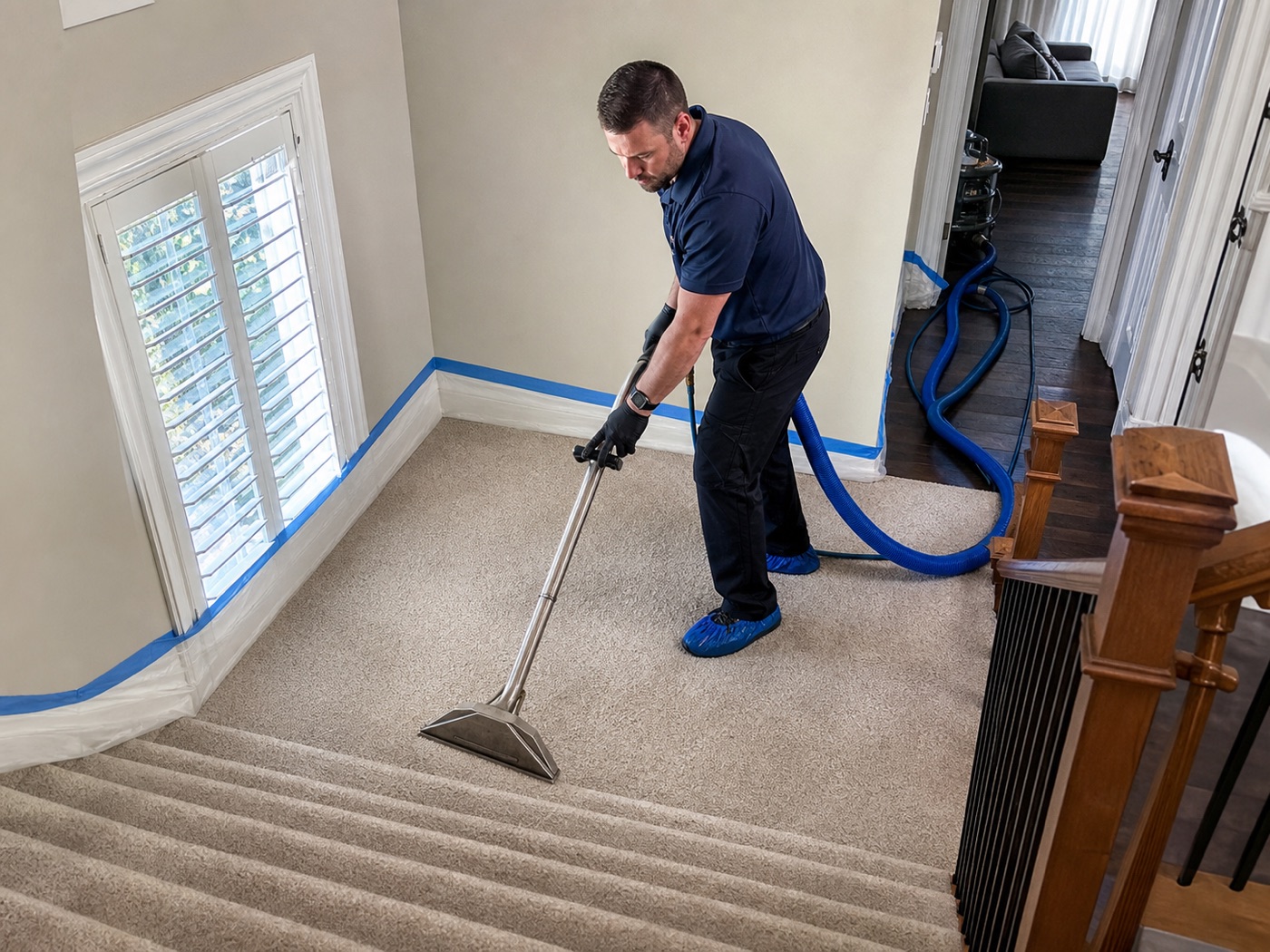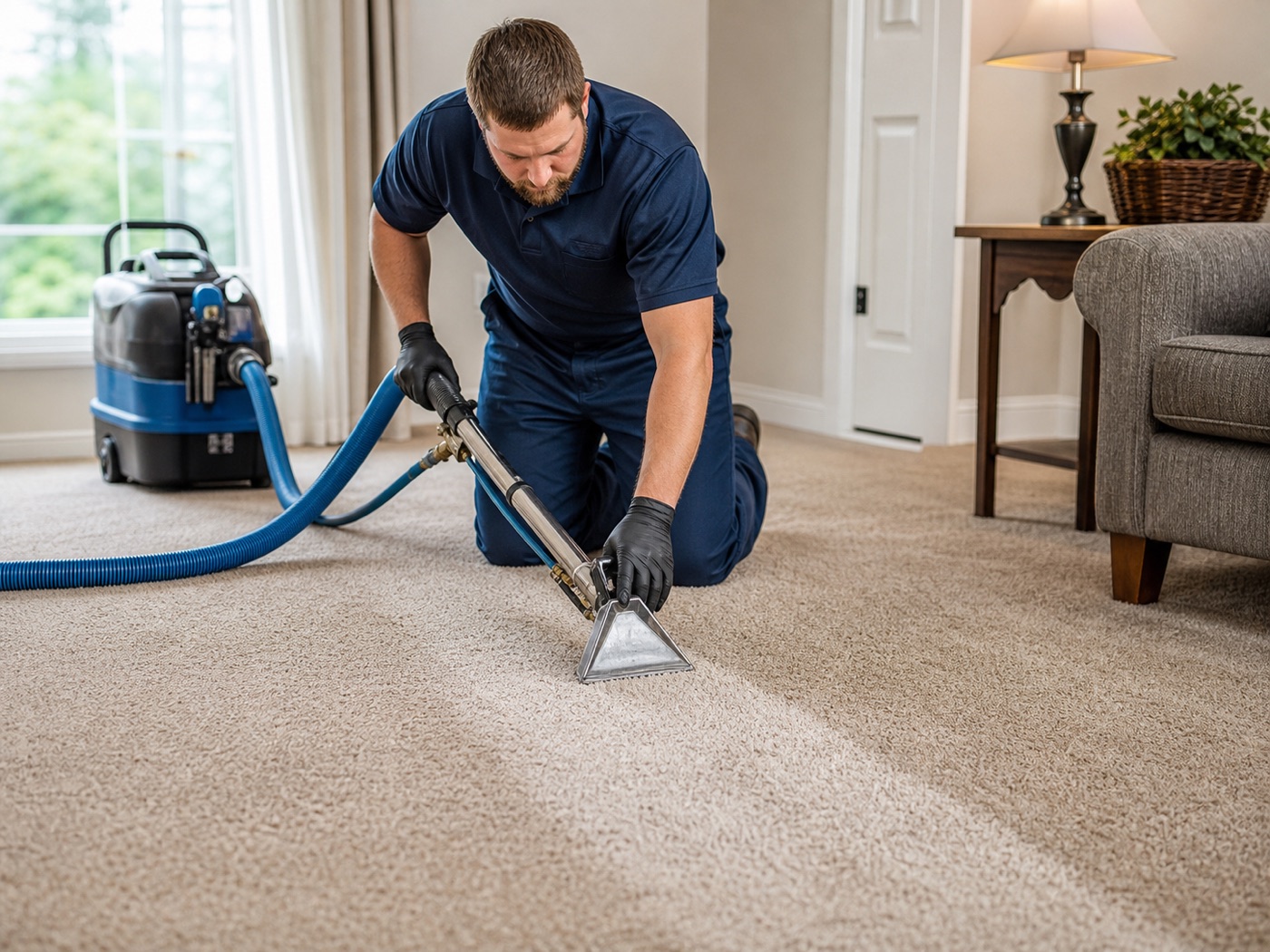

Hampton Roads runs on PCS season. Between Norfolk, Oceana, Little Creek, Langley, Fort Eustis, and everything around them, thousands of households in this region move every year, and a large share of them move in the fall.
The moving parts are well rehearsed by anyone who has done it twice. The part that regularly goes sideways is the cleaning, not because it is difficult, but because it gets scheduled in the wrong place.
The Mistake That Causes Most Problems
The common version looks like this: the movers come on a Thursday, the final inspection is Friday morning, and the carpet cleaning is booked for Thursday afternoon.
Two things go wrong with that. The first is drying. A properly cleaned carpet in September takes four to eight hours to dry in this climate, longer if the humidity is up and the air conditioning has already been turned down. An inspector walking on damp carpet at nine the next morning is looking at a floor that has not finished, and damp carpet looks darker and flatter than it will when dry.
The second is that there is no margin. If the cleaning turns up a pet spot in the pad, a large stain under where the sofa was, or a section that needs a second pass, there is no time to handle it. The whole point of scheduling is to leave room for what you find.
The Eight-Week Timeline
Working backward from the final inspection makes the whole thing manageable.
| When | Do this | Why |
|---|---|---|
| 8 weeks out | Get the written cleaning standard in hand | It determines everything else |
| 6 weeks out | Walk every room and note damage and spots | Problems found now are cheap |
| 4 weeks out | Book the cleaning for the day after pack-out | Fall calendars fill two to three weeks out |
| 3 weeks out | Handle pet urine and repairs | These need time and sometimes a second visit |
| 2 weeks out | Confirm the appointment and the inspection date | Dates move; the cleaner needs to know |
| Pack-out day | Movers take everything | Nothing can be cleaned under furniture |
| Day after pack-out | Carpet cleaning | Empty rooms, full access, time to dry |
| One clear day | Nothing | Drying margin and room for surprises |
| Inspection day | Walk with the invoice and photos in hand | Documentation ends most disputes |
The eight-week item is the one people skip, and it is the most important. Standards vary by installation and by housing partner, and the written version is the only one that counts. Asking for it early means you are working to the actual requirement rather than to what someone in your unit remembers from three years ago.
Why Fall Is Harder Than Summer
Summer is the stereotypical PCS season, but fall in Hampton Roads has its own crush, and it is compressed into fewer weeks.
September and October bring a concentrated wave of moves, and they collide with a second wave of demand: households booking their annual carpet cleaning because fall drying conditions are the best of the year. The result is that the last ten days of each month book solid, and those are exactly the days most leases and housing agreements end.
The practical response is to book as soon as you have dates, and to be flexible about the time of day rather than the day itself. A morning slot is worth asking for — it gives the carpet the full daylight span to dry before anyone needs the space.
The one advantage of a fall move is the weather itself. Dew points have dropped from their August peak, so floors dry considerably faster than they would have two months earlier, and the whole schedule has more slack in it than a July move would.
What to Look For Six Weeks Out
The six-week walkthrough is the one that saves money, and it takes about twenty minutes with a flashlight.
- Pet spots, especially in corners, against walls, and anywhere a crate or a bed sat. A UV light in a dark room finds what the eye misses.
- Traffic lanes between doors, which are normal wear but worth documenting before anyone else characterizes them.
- Furniture indentations and anything that has been hidden under a rug for two years.
- Stains that have already been treated unsuccessfully, since those need different handling than fresh ones.
- Burns, tears, and seam separations, which are repairs rather than cleaning and take their own lead time.
- Any musty note near an exterior wall or a closet, which can indicate a moisture issue that cleaning will not fix.
Pet urine is the item that most often turns a routine move into an expensive one, because a deposit in the pad cannot be resolved with a surface cleaning and it will not pass an inspection that includes an odor check. Found six weeks out it is a scheduled appointment; found the night before the walkthrough it is a bill and an argument.
What the Pack-Out Changes
There is a reason the cleaning goes after the movers rather than before, and it is not only about access.
Carpet under furniture has been protected for the length of the tour. It has not been walked on, it has not taken sunlight, and it has not collected soil, so it is usually lighter and fuller than the carpet around it. When the furniture leaves, those rectangles become visible for the first time, and they are what an inspector sees too.
Cleaning the whole floor at once evens that out. Cleaning around furniture and then moving it three days later leaves you presenting a floor with obvious untouched patches, which reads worse than a uniformly used carpet would have.
The pack-out also surfaces the things that were hidden. A spot behind a dresser, a crate stain in a closet, a section under a rug that never got vacuumed — these appear on pack-out day and they are the reason the schedule needs a day of margin after the cleaning rather than before the inspection.
Documentation Is the Whole Game
Whether you are in privatized housing or renting off base, the outcome of the final inspection depends less on the condition of the carpet than on what you can show about it.
Keep the move-in inspection report. Photograph every room at move-out with the date visible in the file metadata. Keep the itemized cleaning invoice with the service date on it. That package answers nearly every question that can be raised, and it does so without anyone needing to rely on memory.
For service members renting from a private landlord in Virginia, the same rules apply as for any other tenant — normal wear and tear is not deductible, damage is, and the landlord has a defined window to return the deposit with an itemized statement. Knowing where that line sits is worth ten minutes before the walkthrough.
Request to be present at the inspection. It is your right in most arrangements and it changes the conversation entirely, because condition gets discussed while both parties are standing on the same floor rather than through a statement that arrives six weeks later.
The Move-In Cleaning Nobody Books
One more thing worth saying, because it is the most overlooked appointment in the whole cycle: clean the carpet when you arrive, not just when you leave.
You have no idea what the previous household did in that house. The unit may have been cleaned to a standard or it may have been cleaned to a checkbox, and either way you are about to live on that floor for two or three years with your own family and your own pets on it.
A cleaning in the first week of a new assignment is inexpensive, it establishes a documented baseline for the eventual move-out, and it means the floor starts your tour in known condition. Of the three appointments across a typical tour — move in, midpoint, move out — the first is the one most people skip and arguably the one with the best return.
All City Carpet Cleaning And Building Solutions works with military families across Virginia Beach, Norfolk, Chesapeake, Suffolk, Hampton, Portsmouth, and Smithfield, and our area pricing is published so you can plan against a known number. We schedule around orders rather than the other way around.