
Hampton Roads runs on a PCS calendar. Between Naval Station Norfolk, NAS Oceana, JEB Little Creek-Fort Story, Norfolk Naval Shipyard, Coast Guard Base Portsmouth, and Joint Base Langley-Eustis, this region cycles an enormous number of households every summer — with the heaviest surge running from roughly mid-May through September and a smaller wave around December and January.
Which means every service member in the region is trying to book the same services in the same three weeks, usually while also managing a pack-out, a housing appointment, travel, and a report date. The carpet is the thing everyone remembers last and worries about most, because it is the line item most likely to show up on a deposit statement.
What Virginia Law Actually Says
Start here, because the rules are more favorable to tenants than most people assume, and knowing them changes how you negotiate.
Under Virginia's Residential Landlord and Tenant Act, a security deposit is capped at two months' rent. After the tenancy ends and you vacate, the landlord has 45 days to return the deposit or the balance of it, together with a written itemized statement of every deduction. Missing that deadline is significant — a landlord who fails to provide the accounting in time generally forfeits the right to withhold, and a court that finds the failure willful can award damages plus attorney's fees.
The second principle matters just as much: normal wear and tear is not deductible. A lightly worn traffic path through a hallway, minor scuffs, small nail holes, and faded paint are the cost of the property being lived in, and the landlord absorbs them. What can be charged is damage or soil beyond ordinary use — heavy staining, pet urine contamination, burns, tears, or a unit left genuinely dirty.
None of this is legal advice, and your lease terms and situation control. If you end up in a real dispute, base Legal Assistance offices handle exactly this and the service is free to you.
A Realistic PCS Cleaning Timeline
The single most common mistake is scheduling the carpet cleaning too early. The second is scheduling it too late to get a slot at all.
- Four weeks out: read your lease for any cleaning clause, and book the carpet cleaning now. Peak-season weeks fill across the entire region, not just one company.
- Three weeks out: request your move-in condition report if you do not already have it, and start photographing existing damage you did not cause.
- One week out: confirm your appointment and confirm your pack-out date. If the pack-out slips, move the cleaning — do not clean first.
- Pack-out day: let the crews finish completely. Do not clean around boxes.
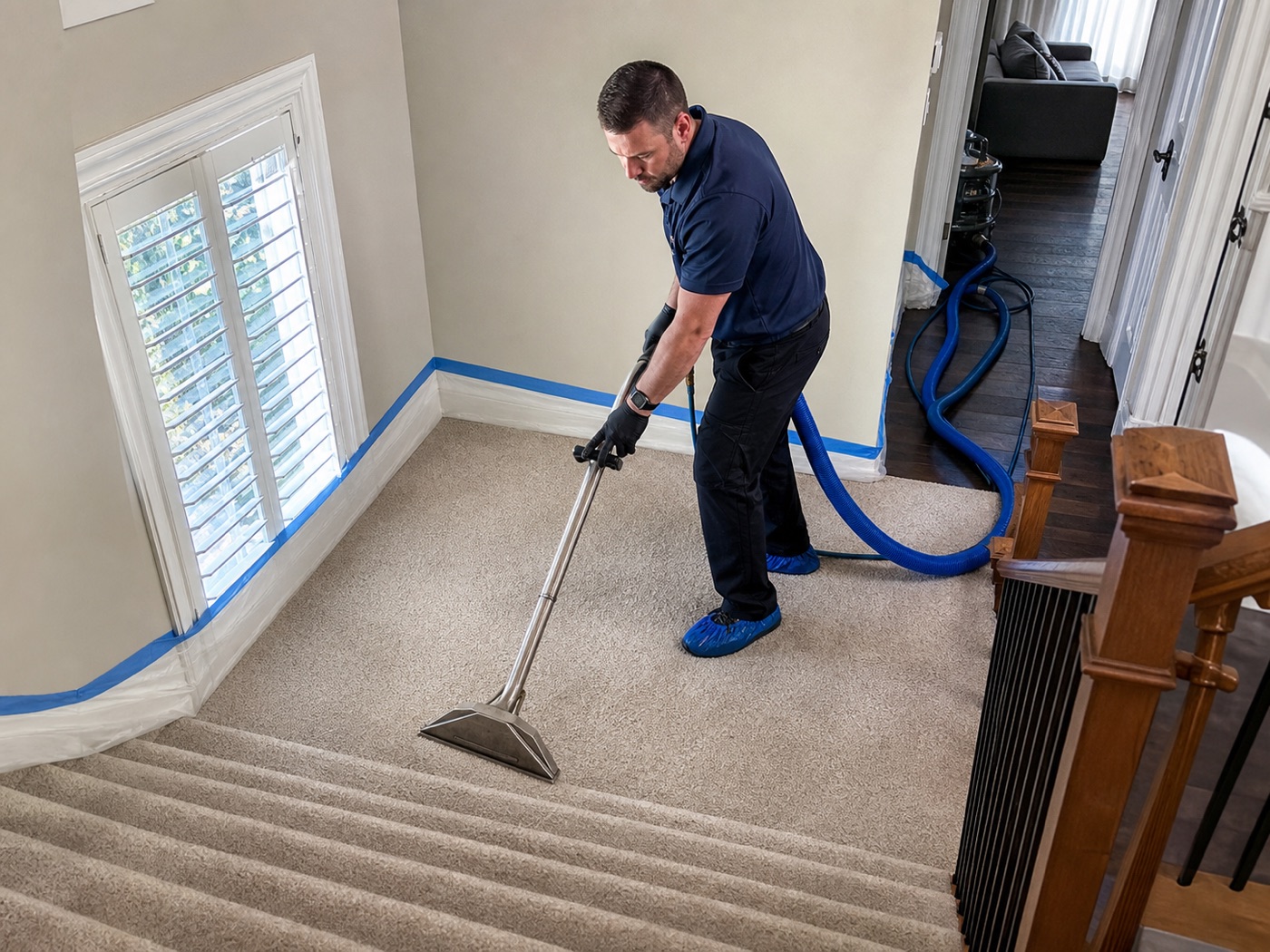
- After pack-out, unit empty: carpet cleaning happens here. An empty unit also means every square foot gets cleaned, including under where furniture stood.
- After cleaning: keep traffic off the carpet, let it dry fully, then do your final walkthrough and photographs.
That sequencing sounds obvious written down and it is routinely done backwards. A move-out checklist that puts each step in order is worth reading before you build your own timeline, because the order is where most of the wasted money hides.
Wear and Tear Versus Damage
This is the line every deposit dispute turns on, and it helps to see it laid out plainly.
| Condition | Usually treated as | What helps |
|---|---|---|
| Lightly worn path down a hallway | Normal wear and tear | Move-in photos showing the carpet's original condition |
| Flattened pile under furniture | Normal wear and tear | Nothing needed; it recovers or it does not, and it is not damage |
| General soil across the unit | Cleaning, not damage | Professional cleaning before the walkthrough |
| Set-in food or drink stains | Damage, arguable | Professional treatment and documentation of the attempt |
| Pet urine reaching the pad | Damage | Honest scoping; sometimes replacement is the real answer |
| Burns, cuts, or bleach spots | Damage | Not correctable by cleaning — plan for the charge or a repair |
The middle rows are where a professional cleaning changes outcomes. A unit that has been properly cleaned, with a receipt, is much harder to bill for cleaning. It also demonstrates good faith on the stain categories — a landlord's position weakens considerably when the tenant can show a professional attempted removal and the mark was permanent fiber damage rather than neglect.
Keep the invoice, and make sure it lists the rooms cleaned and the date. An itemized receipt dated after your pack-out is a much stronger document than a card that says the carpet was cleaned at some point. If your lease has a clause requiring professional cleaning, that receipt is also how you demonstrate you complied with it — a separate question from whether the deduction itself would have been lawful.
Bare rooms are also where a standard residential cleaning does its best work, because there is nothing to clean around. Furniture normally forces a technician to work in sections and leave protected areas untouched, and an empty unit removes that compromise entirely. It is one of the few genuine advantages of a move-out job.
Pets Are the Expensive Variable
Pet damage is where PCS deposits actually get lost, and it is worth being blunt about it. Surface cleaning handles pet-related soil and mild odor well. Urine that has soaked through the carpet into the pad, and sometimes into the subfloor, is a contamination problem rather than a cleaning problem.
A deodorizer sprayed on top of that will smell fine on a cool day in an empty unit with the door open. It will not survive a July walkthrough with the air conditioning off. Treating pet odor at the source is a different scope with a different price, and it is far better to have that conversation three weeks out than the morning of the inspection.
If the contamination is extensive, the honest answer is sometimes that pad replacement is the reliable fix and cleaning will only get you partway. We would rather tell you that while you still have time to decide than take the job and leave you with a surprise. Understanding what deodorizing can and cannot reach makes that decision much easier.
On-Base Housing Versus the Local Rental Market
Privatized base housing and civilian landlords run different processes. Housing offices typically use a standardized inspection checklist and a pre-inspection appointment, which is genuinely useful — ask for the pre-inspection, because it tells you exactly what will be flagged while you still have time to fix it.
Civilian landlords across Norfolk, Virginia Beach, Chesapeake, and Portsmouth vary widely. Some are meticulous; some barely walk the unit. Either way, the statutory 45-day clock and the wear-and-tear standard apply, and your leverage comes from documentation rather than from how reasonable the landlord seems.
Property managers handling multiple units are a third category, and they usually have a standing relationship with a cleaner. If yours does, that is fine — just make sure you know whether the cost is being billed to you and at what rate. Our published pricing is available so you can compare rather than guess.
The Short Version
Virginia gives you a 45-day accounting, a two-month deposit cap, and a wear-and-tear standard that is genuinely on your side. What you have to supply is documentation, correct sequencing, and enough lead time to get on a calendar during the busiest weeks of the year in a region that moves tens of thousands of people every summer.
All City Carpet Cleaning And Building Solutions works with service members and families across Norfolk, Virginia Beach, Chesapeake, Portsmouth, and Hampton, and we understand the timeline you are working against. Tell us your pack-out date and we will work backward from it. If the date moves — and it does move — tell us and we will move with it rather than making you start the scheduling process over.