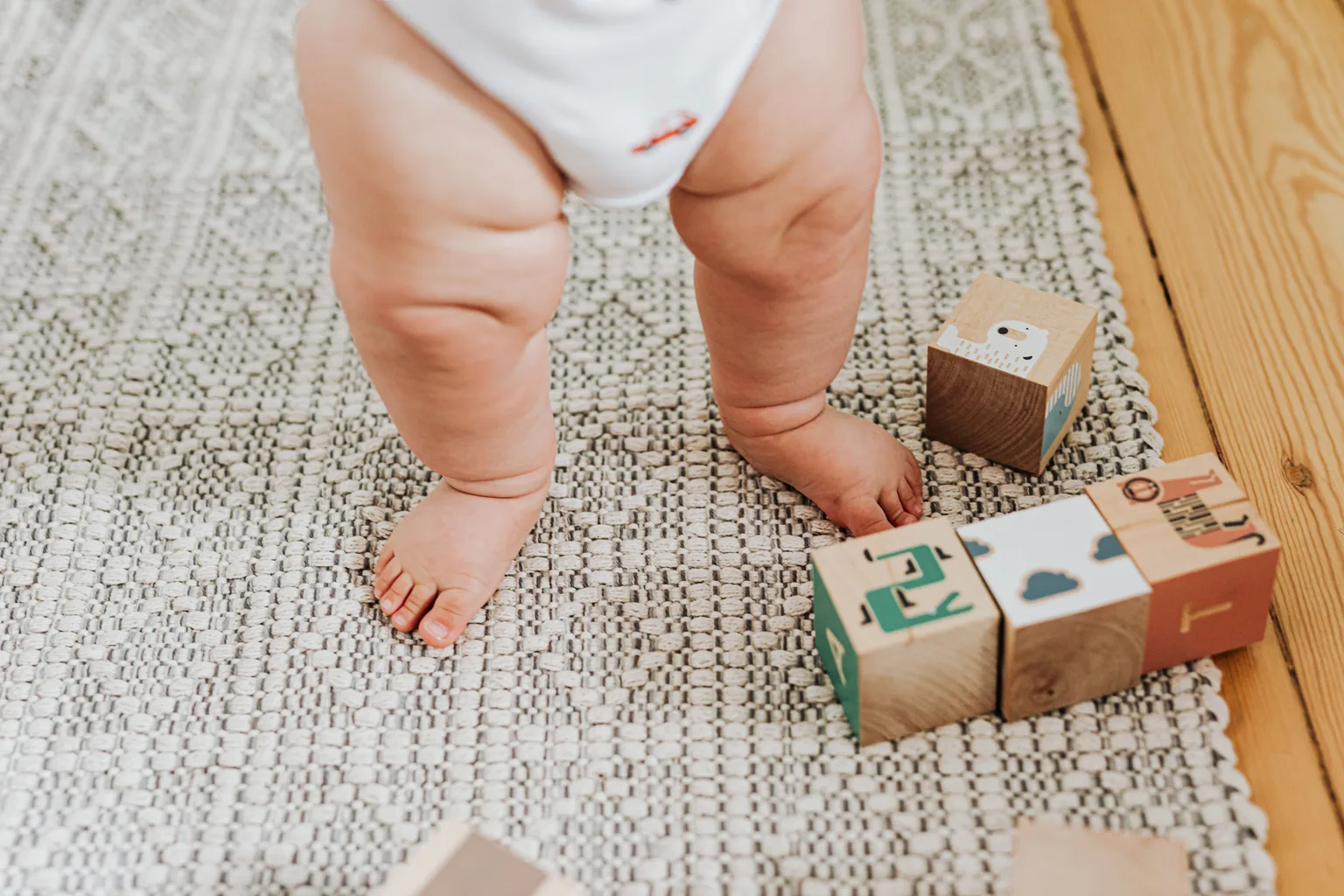

Every commercial floor has a use pattern. In an office people walk on the carpet. In a restaurant they walk on it and drop things on it. In a childcare center, children sit on the floor, roll on it, eat on it, nap on it, and put their hands on it and then in their mouths, for eight to ten hours a day.
That single fact changes every assumption. A classroom floor is not a walking surface with a cleaning schedule. It is a contact surface, and it should be maintained the way contact surfaces are.
Why Residue Is the Main Question
In most commercial work, detergent residue is a performance problem — it attracts soil and makes the carpet get dirty faster. In childcare it is that plus something more direct.
Whatever stays in the fiber after cleaning is what a two-year-old's hands contact for the next three months. That reframes the conversation away from which product is strongest and toward how completely everything used is rinsed back out.
So the specification for a childcare center is straightforward to state: appropriate chemistry for the soil, thorough rinsing, no fragrance, no deodorizer, and enough extraction that the carpet is not left holding anything. It is the same standard that makes sense in a nursery at home, applied to a room with twenty children in it.
Fragrance deserves its own line. A deodorized classroom smells clean and that is exactly the problem — it masks conditions staff should be noticing, and it adds compounds to a room full of developing respiratory systems for no functional benefit. If a room smells, something in it needs to be found and removed.
What Actually Accumulates
Classroom carpet collects a specific mix, and knowing it shapes the cleaning approach.
| Source | What it leaves | What removes it |
|---|---|---|
| Snack and lunch | Sugars, oils, protein | Extraction with appropriate chemistry |
| Juice and milk spills | Sugar residue, sour odor | Sub-surface work if it reached the backing |
| Toileting accidents | Urine in backing and pad | Urine-specific treatment, not general cleaning |
| Outdoor play | Sand, mulch, grass, mud | Dry soil removal plus extraction |
| Art supplies | Paint, glue, marker, glitter | Spot-specific chemistry |
| Nap mats | Body oil and moisture at the floor interface | Extraction, and lifting mats to dry |
| Hands and feet | Skin oil, general handling | Regular extraction |
Milk and juice are the underestimated ones. Both leave sugars that feed bacteria, and if a spill reaches the backing it produces a sour note that grows over weeks. A center with an odor nobody can locate is usually standing on a spill from a month earlier that was blotted from the surface and never extracted.
Toileting accidents in toddler rooms need urine-specific treatment rather than general cleaning, for the same reason they do in a house: the deposit goes into the backing and the pad, and surface cleaning never reaches it. A center that handles these properly as they happen avoids the slow accumulation that makes a room smell by spring.
Soil Removal Versus Disinfection
There is a persistent expectation in childcare that carpet should be disinfected, and it is worth addressing directly rather than selling into it.
Disinfectants are validated on hard, non-porous surfaces with a specified contact time — usually several minutes of visible wetness. Carpet is porous, has enormous surface area, and cannot be kept uniformly wet for a label contact time without over-wetting it. A spray application on carpet is therefore doing considerably less than the label suggests, while leaving product behind in the fiber.
What does work is removing the organic material. Microorganisms need a food source, and food residue, body soil, and biological material are that source. Thorough hot water extraction takes it out of the building rather than treating it in place, which is a more meaningful reduction than a surface application achieves.
Hard surfaces are the opposite case and should be treated that way. Diaper changing areas, sinks, tables, and bathroom floors are where disinfection genuinely belongs, and that is daily staff work rather than a quarterly contractor visit.
Scheduling Around a Center
The operational constraint in childcare is unforgiving: many centers open at six in the morning and the last child leaves after six in the evening, five days a week.
Friday evening is usually the right slot for restorative work. Carpet cleaned Friday night has the full weekend to dry and air out, and the classroom that reopens Monday is completely dry with no lingering anything. In Hampton Roads, where humidity can stretch drying times well past what they would be inland, that weekend margin matters.
Interim work is a different problem, because accidents do not wait for Friday. Low-moisture methods return a room to service within an hour or two and are the right tool for a midweek response — not a substitute for periodic extraction, but a good complement to it.
Summer sessions and holiday closures are the windows for anything larger — hard floor restoration, tile and grout resets in bathrooms and kitchens, and the rooms that need more than a standard visit. Centers that plan those into the calendar in advance pay less and disrupt less than centers that call in a crisis.
Carpet or Hard Floor in a Classroom
Directors planning a renovation ask this constantly, and the honest answer is that both work and each fails differently.
Carpet is warmer, quieter, and considerably safer for children who are still learning to walk and fall frequently. Sound absorption is not a small point in a room with twenty toddlers — noise levels drive both staff fatigue and children's behavior. Carpet also traps particulate out of the air, which helps as long as the reservoir gets emptied on a schedule.
Hard flooring is easier to disinfect, dries immediately, and does not hold a spill in a backing. It is the right answer for eating areas, art corners, sinks, and anywhere near a bathroom. It is also louder, colder, and less forgiving of a fall.
Most well-designed centers use both and put the boundary in the right place: carpet or a large washable rug in the circle-time and play area, hard surface everywhere food and water go. What matters more than the choice is that each surface gets the maintenance its material actually needs rather than a single building-wide schedule.
Virginia's childcare regulations require sanitary conditions without prescribing a specific carpet cleaning method, which leaves centers to demonstrate compliance through practice and paperwork.
The practical answer is a written floor care schedule that names each area and its interval, invoices from the contractor that match that schedule, a documented procedure for handling accidents and spills, and safety data sheets for anything kept on site. That package answers an inspector's questions without anyone needing to improvise.
It also answers parents' questions, which arrive more often and with more emotion. A center that can say plainly how often classroom floors are extracted, and what is and is not used on them, is in a considerably better position than one that says the floors are cleaned regularly.
The same logic applies to every surface in the building. Bathroom and kitchen grout is porous, holds what it absorbs, and looks dingy long before anyone would call it dirty — and it is the surface parents notice on a tour.
What Staff Can Do Between Visits
Most of the outcome is daily practice, and the list is short enough to post on a wall.
- Vacuum classroom carpet daily, slowly, with a machine whose filter is actually intact. Speed is why most vacuuming misses the grit.
- Blot spills immediately with water and white towels, and skip the spray bottle — residue is the part that stays.
- Report any accident that soaked in rather than wiping the surface and moving on. Those are the ones that become odor.
- Lift nap mats daily so the floor underneath dries, particularly through the humid months.
- Keep real walk-off matting at every entrance, long enough for several steps, and shake it out often.
- Log spills and accidents by room so patterns become visible before they become smells.
The logging habit is the one directors tell us pays off most. A room that shows six accidents in the same corner over a month has a floor problem that a quarterly cleaning schedule will not catch on its own, and finding that in the log is much cheaper than finding it in a licensing visit.
All City Carpet Cleaning And Building Solutions works with childcare centers, preschools, and schools across Virginia Beach, Norfolk, Chesapeake, Suffolk, Hampton, Portsmouth, and Smithfield, scheduling around opening hours rather than ours.