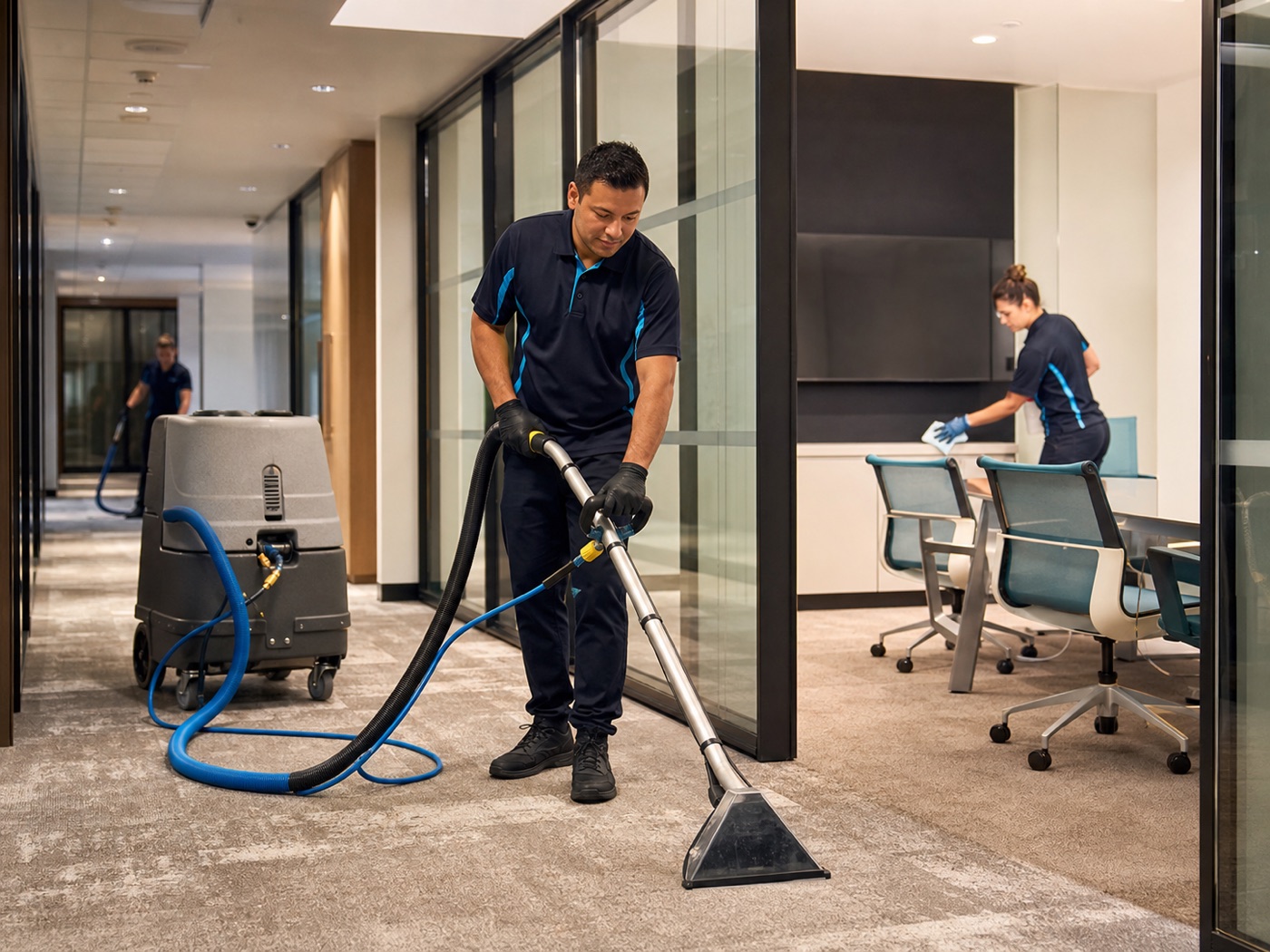
Walk into most commercial buildings and the carpet cleaning contract behind the scenes says the same thing for every square foot: cleaned quarterly, or cleaned twice a year, applied uniformly from the lobby to the back-corner file room nobody has entered in a month.
It is an easy number to write into a contract and a genuinely poor match for how a building actually gets used.
Traffic Is Not Uniform
A typical office building has at least four distinct traffic zones, and they do not accumulate soil at anything close to the same rate.
The entry zone — roughly the first fifteen feet inside any exterior door — takes the brunt of everything tracked in from outside: rain, sand, salt in winter, and whatever soil is on the shoes of every single person who enters. It is a small fraction of a building's total carpeted area and a large fraction of its total soil load.
Circulation paths — the main hallways connecting the entry to elevators, restrooms, and break areas — take secondary but still substantial traffic, since everyone in the building crosses them multiple times a day. Workstation and private office areas take much lighter traffic, largely limited to the people who work there. And storage, conference, and rarely used rooms take the least traffic of all, sometimes going weeks between a single footstep.
The Cost of Uniform Scheduling
A single cleaning frequency applied across all four zones produces two failures at once. The entry zone, cleaned on the same quarterly schedule as everywhere else, looks visibly worn and grey well before its next cleaning — it is the first thing a visitor sees and it is usually the zone showing the most wear. Meanwhile the storage room gets cleaned just as often as the entry, consuming budget on a surface that barely needed it.
This is the same logic that applies to residential scheduling by household type, just at building scale — the right interval depends on what actually happens on the surface, not on a single number that is easy to write into a contract.
Building a Zone-Based Schedule
Rather than one interval for the whole building, a zone-based approach assigns a frequency to each area based on actual traffic, and it usually lands somewhere like this for a typical office property.
| Zone | Typical interval | Why |
|---|---|---|
| Entry / lobby (first 15 ft) | Monthly | Takes soil from every entry; visible to every visitor |
| Main circulation halls | Bimonthly | Crossed by everyone, multiple times daily |
| Break rooms / cafeterias | Monthly | Food and drink spills add to foot traffic |
| Private offices / workstations | Semi-annually | Light, contained traffic from occupants only |
| Conference / storage rooms | Annually | Minimal, occasional traffic |
The total spend across a zone-based schedule tends to land close to what a uniform quarterly contract already costs, because the extra visits to high-traffic zones are offset by the reduced visits everywhere else. It is the same budget, spent on the parts of the building that actually need it.
Matting Changes the Whole Equation
Nothing extends a cleaning interval more cheaply than proper entry matting, and it is the single most underused tool in commercial floor care.
A walk-off mat system — one section outside the door and a longer run of scraper-and-wiper matting just inside it — captures a large share of soil and moisture before it ever reaches the carpet. Properties with genuinely adequate matting can often stretch their entry-zone interval from monthly toward bimonthly, because there is measurably less soil arriving in the first place.
The failure mode is a mat that is too short, too worn, or simply absent from a secondary entrance that staff use more than the marked front door. If deliveries or staff routinely use a side door with no matting at all, that door is functioning as an unmanaged entry zone regardless of what the lease says the main entrance is.
Carpet Type and Visibility Matter Too
Two zones with identical traffic can need different intervals if the carpet itself is different. Dense, low-pile commercial loop carpet — the standard in most modern office buildings — hides soil reasonably well and holds up to frequent cleaning without matting or fraying.
Cut-pile or higher-plush carpet, more common in executive suites and reception areas meant to feel residential, shows soil and traffic patterns faster even at the same foot count, and can need a shorter interval purely because appearance degrades before soil load technically justifies cleaning. Budgeting by traffic alone misses this; visibility and material both belong in the decision.
Seasonal Adjustments to the Base Schedule
A zone-based schedule is a strong starting point, but it should flex with the calendar rather than staying static all year, because traffic and soil load are not constant across the seasons in this region.
Winter months bring salt, sand, and moisture tracked in on every pair of shoes, which argues for shortening the entry-zone interval during that stretch even if the rest of the year sits on a longer cycle. Summer brings a different soil profile — sunscreen, pool chemicals for properties near amenity areas, and simply more foot traffic as people are out and about more. A building that adjusts its entry-zone frequency seasonally, rather than locking in one number for the whole year, gets more out of the same total spend.
Retail and hospitality properties see the most dramatic seasonal swings, with holiday shopping traffic in November and December often justifying a temporary move to weekly or biweekly entry cleaning regardless of what the rest of the year's contract specifies.
Who Should Own the Schedule
In a lot of buildings, the carpet cleaning schedule is set once when a vendor contract is signed and then never revisited, even as tenants change, space gets reconfigured, and traffic patterns shift entirely from what they were at signing.
Facility managers get the best results treating the schedule as a living document, reviewed at least annually alongside lease renewals and any space planning changes. A conference room that becomes a shared workspace, or a storage room that becomes a new department's office, moves from a low-traffic zone to a moderate one, and the cleaning frequency should move with it. This is a five-minute conversation during an annual walkthrough, not a renegotiation of the whole contract.
Property managers overseeing multiple buildings benefit from applying the same zone framework across their portfolio, since it turns an otherwise subjective judgment call into a repeatable process that a new manager can pick up without starting from scratch.
Putting It Into a Contract
The practical version of all this is a short walkthrough with whoever manages the property, rating each zone on a simple high, medium, or low traffic scale and assigning intervals from there. It takes less than an hour for most buildings and it is worth revisiting annually as space use shifts — a room that was storage last year and is a new hire's office this year has moved zones.
It also helps to document the reasoning behind each zone's interval, not just the interval itself, so a future facilities manager or a new vendor inherits the logic rather than a set of numbers that look arbitrary a few years later. A one-page zone map with traffic ratings attached takes an afternoon to build and saves a lot of re-litigating down the road.
A vendor that pushes back on a zone-based approach and insists on a single flat number for the whole building is often optimizing for scheduling simplicity on their end rather than results on yours, and it is a fair question to ask directly during a vendor selection process, before a contract locks in an approach that does not fit how the space is actually used.
All City Carpet Cleaning And Building Solutions builds commercial schedules around actual traffic rather than a flat number, for offices, medical suites, and retail spaces across Virginia Beach, Norfolk, Chesapeake, Suffolk, Hampton, Portsmouth, and Smithfield.