
Anyone who has run a business out of a leased office, retail space, or medical suite in Hampton Roads has probably signed a lease with a line somewhere in the surrender or restoration section requiring professional carpet cleaning before the keys go back. Most tenants skim past it during signing and only think about it again in the final weeks of the lease, usually while packing.
That clause is not filler language. It exists because commercial real estate operates on a much tighter turnover timeline than residential rental housing, and landlords have real financial reasons to require it as a lease condition rather than leave it to chance.
How This Differs From Residential Rules
Residential landlords in Virginia generally cannot charge a departing tenant for carpet cleaning tied to ordinary wear and tear — that cost is treated as a normal cost of doing business, and security deposit deductions are limited to damage beyond normal use. A lot of people carry that assumption into a commercial lease and it simply does not apply there.
Commercial leases are negotiated contracts between businesses, not consumer protection instruments, and landlords write them with far more latitude to shift maintenance costs onto tenants. A surrender clause requiring professional carpet cleaning, regardless of the carpet's actual condition, is common and enforceable because both parties are presumed to have negotiated or at least reviewed the terms before signing.
The mechanics also differ. A residential landlord typically inspects and deducts from a deposit. A commercial landlord more often requires a receipt for professional cleaning as a condition of lease closeout, sometimes specifying the cleaning method or requiring it be done within a set number of days before the surrender date.
Why Landlords Actually Care About This
Commercial space between tenants generates no rent, and every day a suite sits unleased or unpreparable for showing costs the landlord real money. A commercial landlord showing a vacated office to a prospective tenant with stained, matted carpet is showing a worse product, and that translates directly into slower lease-up and lower asking rent.
There is also a practical timing issue specific to commercial space. Residential units often sit vacant for a couple of weeks between tenants. Commercial space, especially in office parks and retail strips around Virginia Beach and Chesapeake, is frequently marketed for the next tenant before the current one even moves out, and the landlord needs the unit presentable on a compressed schedule with no room for a dispute over who is responsible for cleaning.
Requiring the outgoing tenant to handle it, on a set schedule, with proof of service, removes that scheduling risk from the landlord's side entirely. It is a lease term built around logistics as much as it is about cost allocation.
What the Clause Usually Requires
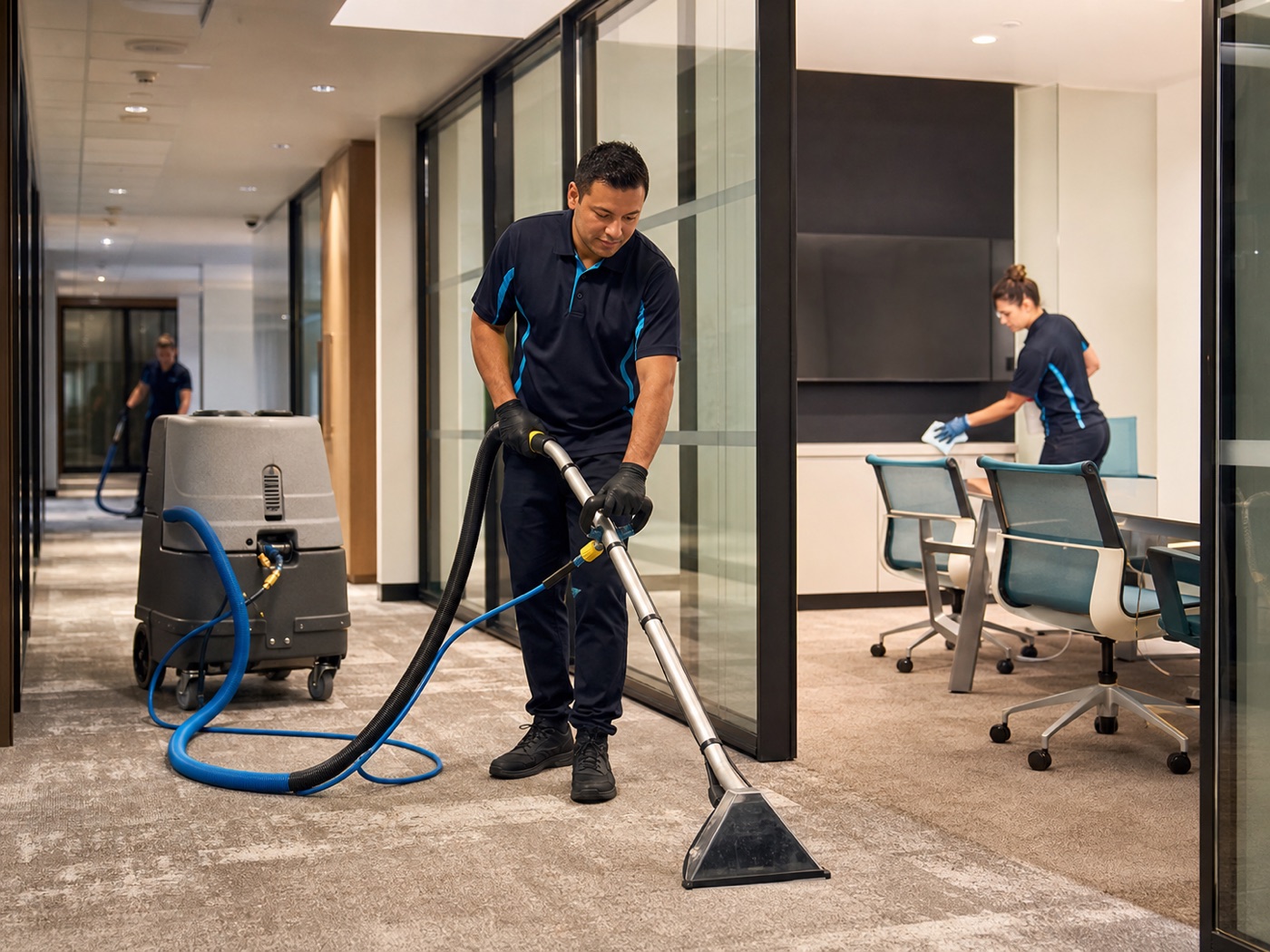
Lease language varies, but a few patterns show up repeatedly across the commercial leases handled in this market. Many require professional cleaning specifically — not tenant self-cleaning — and some name a method, such as hot water extraction, rather than leaving the method open.
Others tie the requirement to a specific timeframe before the surrender date, commonly within five to fourteen days, so the space is still clean when the landlord actually takes possession rather than cleaned early and re-soiled during the final move-out days. Some go further and require a paid invoice or work order be delivered to the landlord or property manager as documentation, not just a verbal assurance the work happened.
- A named cleaning method or standard (commonly hot water extraction for carpet)
- A required window before the surrender or lease-end date
- Written proof of service, such as an invoice or work order
- Coverage of common areas the tenant used exclusively, not just the private suite
- A holdover or penalty provision if cleaning is not completed on schedule
Office suites, medical and dental practices, and retail storefronts all see some version of this clause, though the specifics differ by property type. A dental office lease, for instance, often folds carpet cleaning into a broader sanitation and infection-control restoration requirement given the nature of the practice.
Retail leases sometimes go a step further and separate the sales floor from the back-of-house stockroom, requiring different treatment for each because the traffic patterns and soil types differ so much between the two. A shoe store's sales floor sees a different kind of wear than its stockroom, and some landlords write the lease to reflect that distinction directly rather than treating the whole leased footprint as one uniform space.
Multi-tenant office buildings frequently add a clause covering shared corridors and elevator lobbies the tenant used, not just the private suite behind the tenant's own door, since those common areas absorb wear from every tenant's foot traffic and landlords want a mechanism for allocating that cost fairly across everyone who used the space during the lease term.
What Happens When a Dispute Actually Arises
Most commercial carpet cleaning clauses never become a real dispute, because the requirement is clear enough that tenants simply comply and move on. When disagreements do happen, they usually center on one of two things: whether the cleaning that was done meets the standard the lease describes, or whether the landlord's claimed cost for hiring a replacement cleaner was reasonable.
A landlord claiming an inflated cleaning cost after a tenant failed to handle it themselves is a real risk worth avoiding simply by complying with the lease on the front end. Courts reviewing a commercial lease dispute generally give real weight to the written terms both parties signed, which is exactly why the documentation habit — dated invoice, named method, square footage covered — matters as much as doing the cleaning itself. A tenant who did the work but kept no proof of it is in a weaker position than one who simply never scheduled the cleaning and negotiated a deduction upfront.
The Landlord and Property Manager Side of This
For landlords and property managers, the clause only works if it is actually enforced consistently, and the practical version of enforcement is building carpet cleaning into a documented turnover checklist rather than trusting every outgoing tenant to remember a line from a lease signed years earlier.
Property managers overseeing multiple commercial buildings in Norfolk or Suffolk tend to standardize this — same cleaning requirement language across leases, same proof-of-service requirement, and a clear consequence spelled out for noncompliance, usually a deduction from a letter of credit or direct bill-back at a set rate per square foot. Standardizing it removes the ambiguity that causes most disputes.
It also protects the landlord's ability to market the space at full rate immediately. A suite that needs cleaning before it can be shown loses leasing momentum, and in a market where commercial vacancy carries real carrying costs, that momentum is worth protecting through a clearly worded, consistently enforced lease clause.
What Tenants Should Do Before Move-Out
The lowest-friction approach for an outgoing business is simple: read the surrender clause early, well before the final weeks of the lease, and schedule professional cleaning inside whatever window the lease specifies rather than waiting until the last few days when moving trucks and furniture removal are competing for the same time slots.
Getting an itemized invoice from the cleaning company, showing the date, the method used, and the square footage covered, is worth requesting specifically, since that document is usually exactly what the landlord wants as proof. A generic receipt without those details sometimes gets rejected as insufficient documentation, which forces a second cleaning visit under time pressure.
If the lease names a specific method or vendor requirement, confirm the cleaning company can meet it before booking — commercial carpet in high-traffic corridors and lobbies often needs a different approach than the private offices behind it, and a landlord reviewing the invoice may check that the whole leased footprint was addressed, not just the visible reception area.
All City Carpet Cleaning And Building Solutions works directly with tenants, landlords, and property managers across Virginia Beach, Norfolk, Chesapeake, Suffolk, Hampton, Portsmouth, and Smithfield on commercial turnover cleaning, with documented invoices that satisfy standard lease requirements and transparent pricing available upfront.